North
North Ranger & Rover: Full Brand Overview (2026)
North Action Sports (formerly North Kiteboarding) is one of the biggest names in kitesurfing. Their entry into parawingfoiling came with the Ranger, a wing designed specifically for downwind foiling: deploy it to get up on foil, then stash it and ride unpowered. They've since added the Rover, an upwind-capable all-rounder that broadens their offering.
This page covers who North are, what the Ranger and Rover offer, and where they fit in the wider parawing market.
About North
North Action Sports is based in Austria and is part of the Boards & MORE Group, which also owns Duotone, Fanatic, ION, and Flysurfer. The brand has deep roots in kiteboarding, with products spanning kites, boards, harnesses, and accessories. Their design and engineering team draws on decades of wind sport experience.
North's approach to parawingfoiling is distinctive. Rather than building a general-purpose parawing to compete with the F-One Frigate or Ozone Pocket Rocket, they targeted a specific use case: downwind foiling. The Ranger was designed as a launch aid and power source to get you up on foil, with the expectation that you'd stash it once riding and continue on swell or ocean energy alone.
The subsequent Rover model addresses the gap the Ranger left: riders who want to tack upwind, ride crosswind loops, and use the parawing as a continuous power source rather than a launch tool.
North Ranger
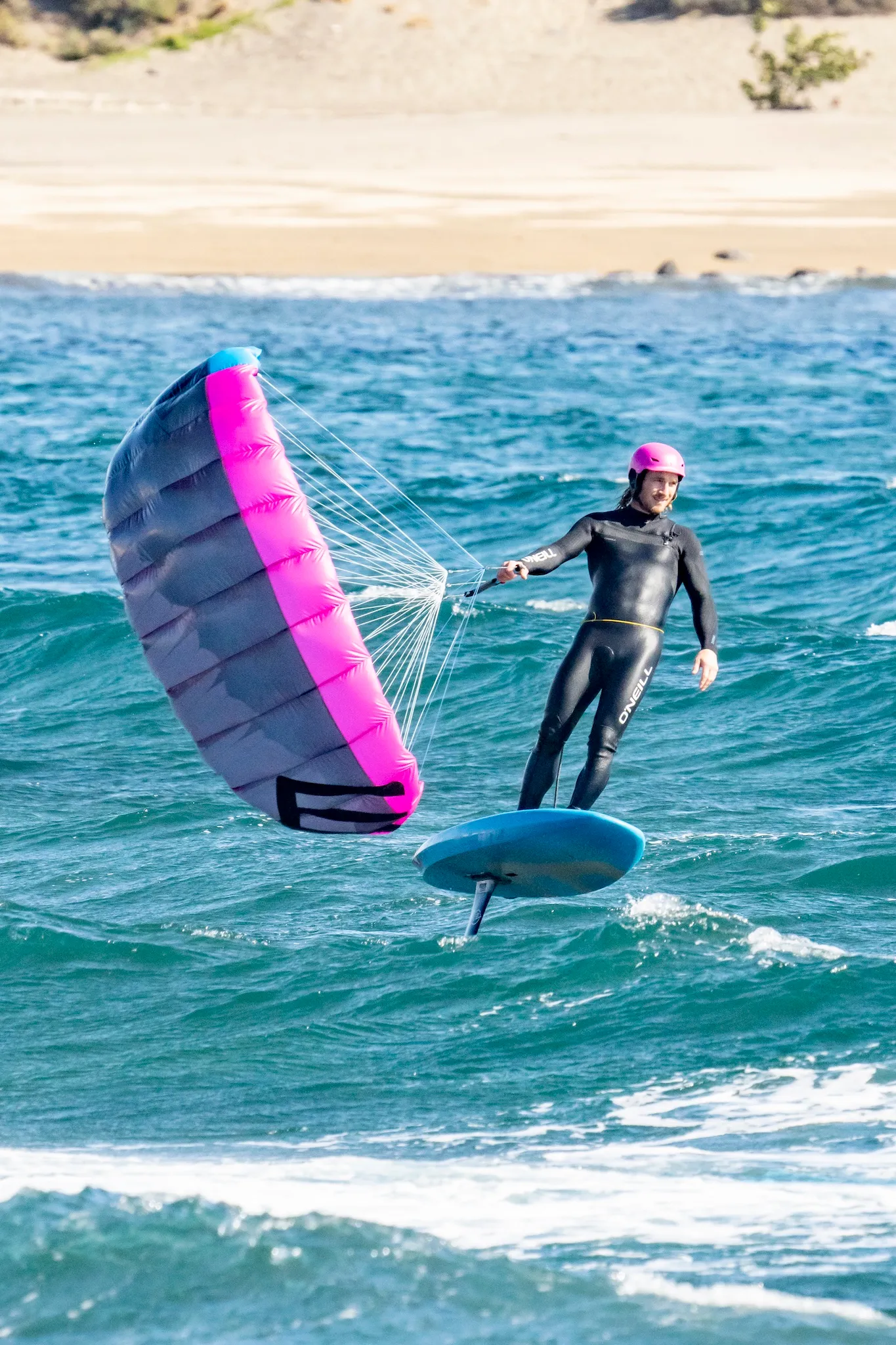
The Ranger is North's downwind specialist. It's designed for a specific workflow: deploy the parawing, get up on foil, ride downwind, stash the wing, and continue foiling on swell or ocean energy. The design priorities are fast deployment, strong low-end power for getting on foil, and compact stowage.
Available Sizes
| Size | Wind Range (knots) | Weight |
|---|---|---|
| 2.2m | 25–40 | 1,200g |
| 3.2m | 18–26 | 1,300g |
| 4.2m | 14–20 | 1,350g |
| 5.2m | 10–15 | 1,450g |
Wind ranges based on an 85kg rider with a DW1100 foil and Midi 96L board.
Key Features
D-Rib technology. North's proprietary diagonal canopy support system distributes load across the canopy while reducing the number of bridles required. This keeps the wing stable during depower and simplifies the bridle system.
Depower Tab. A unique feature located midway along the fluorescent yellow leading edge bridle line. It acts as a handbrake to dump power mid-flight. You can also hook it on the bar end to maintain a depowered state while riding. No other parawing brand offers this specific power management approach.
Extra-short bridles. Designed for rapid deployment and retrieval. The short bridle length means the wing packs smaller and deploys faster than longer-bridled competitors.
Colour-coded bridle lines. Visual orientation is fast, with the fluorescent yellow leading edge bridle standing out clearly.
Lightweight carbon bar. One-handed flying compatible. Designed for harness use with the North Wing Harness Loop.
Ranger Pricing
| Size | EUR | USD (approx.) |
|---|---|---|
| 2.2m | €599 | ~$650 |
| 3.2m | €649 | ~$700 |
| 4.2m | €699 | ~$750 |
| 5.2m | €749 | ~$810 |
GBP pricing varies by retailer. USD pricing from US dealers ranges more widely ($549 to $979 depending on size and retailer).
North Rover
The Rover is North's answer to riders who want more than a downwind launch tool. It's designed for upwind drive, expanded wind range, and continuous powered riding. Where the Ranger is a specialist, the Rover is the all-rounder.
North describes the Rover as having "unbeatable upwind drive and an expansive wind range." Full size and spec details are still emerging as the model rolls out to dealers.
Price: €849 (higher than the Ranger, reflecting the broader capability).
How the Ranger Differs from Other Parawings
The Ranger fills a specific niche that most other parawings don't target. Where the F-One Frigate and Ozone Pocket Rocket are designed as continuous power sources for upwind/downwind loops and extended sessions, the Ranger is designed to get you on foil and then get out of the way.
This shows in the specs. The Ranger is heavier than most competitors at equivalent sizes (1,350g for a 4.2m vs 520g for the Frigate 4.0m or 640g for the Pocket Rocket 4.3m). That extra weight comes from the 40 GSM fabric and construction approach, which prioritises durability and low-end power over minimum weight.
The Ranger's upwind ability is intentionally limited. North has acknowledged this openly, noting that upwind-focused models (the Rover) are designed for that purpose. If you want to tack upwind and ride crosswind loops, the Ranger is not the right choice. If you want a deployment tool for downwind runs and wave sessions, it's purpose-built.
The Inertia's Assessment
The Inertia's comprehensive parawing test rated the Ranger positively for its intended use case. They praised the solid construction, clean 3-line bridle-bar connection, and excellent low-end power for getting up on foil. The limitation on upwind ability was noted as a known trade-off rather than a flaw.
Versatility Beyond Foiling
North positions the Ranger as more versatile than a pure parawing. They list it as usable for:
- Primary parawing for downwind foiling
- Rescue chute for wing foilers and paddlers (deploy if you lose power)
- Launch aid for downwind sessions
- Land use: mountain boards, skateboards, and other traction applications
The rescue chute angle is interesting. For wingfoilers in marginal conditions, carrying a stashed Ranger as a backup power source is a genuine safety option.
Pros and Cons
Pros:
- Purpose-built for downwind foiling: fast deploy, strong low-end, compact stow
- Depower Tab is a unique and useful power management feature
- D-Rib technology simplifies the bridle while maintaining stability
- Competitive pricing (€599 to €749)
- Colour-coded bridle lines for quick orientation
- Backed by a major brand with global dealer network (shared with Duotone)
- Versatile use cases beyond pure parawingfoiling
Cons:
- Significantly heavier than competitors at equivalent sizes
- Limited upwind ability (acknowledged by North as a design choice)
- Not suited for upwind/downwind loop riding or extended powered sessions
- Newer to the parawing market with less community feedback than established brands
- The Rover (upwind model) is still early in its rollout with limited real-world data
Where to Buy
UK dealers:
- Fluid Lines (fluid-lines.co.uk)
- King of Watersports (kingofwatersports.com)
US dealers:
- REAL Watersports (realwatersports.com)
- MACkite Boardsports (mackiteboarding.com)
- Windance (windance.com)
- Gorge Performance (gorgeperformance.com)
- Green Hat Kiteboarding
EU dealers:
- Kiteworldshop.com
- Wake-Style.com (Germany)
- Boardsports.eu
- Surfpirates.de (Germany)
Australian dealers:
- Kite Republic (kiterepublic.com.au)
- Kitepower Australia
- Binks Marine
Frequently Asked Questions
Is the North Ranger good for beginners?
The Ranger is straightforward to use for its intended purpose (deploy, ride downwind, stow). However, the limited upwind ability means beginners can't ride back to their launch point. It's best suited for riders who already have a downwind plan (shuttle, walking back, or riding spots where the wind takes you to a safe landing). For all-round parawingfoiling as a beginner, the Gong Lowkite or Aeryn P1 are better starting points.
What's the difference between the Ranger and the Rover?
The Ranger is the downwind specialist: strong low-end power, fast deploy/stow, limited upwind. The Rover is the upwind all-rounder: designed for tacking, crosswind loops, and continuous powered riding. If you want to ride upwind, get the Rover. If you want a launch tool for downwind sessions, get the Ranger.
How does the Ranger compare to the BRM Maliko 2?
Both target downwind riding. The BRM Maliko 2 is significantly lighter (418g for a 4.1m vs 1,350g for the Ranger 4.2m) and more packable, but costs more and ships from Hawaii. The Ranger is heavier but cheaper and easier to buy through North's global dealer network. If minimum weight is the priority, BRM wins. If accessibility and price matter more, the Ranger is the easier choice.
Is North the same company as Duotone?
They're sister brands under the Boards & MORE Group, along with Fanatic, ION, and Flysurfer. They share distribution infrastructure but maintain separate design teams and product lines. The North Ranger and Duotone Stash are different products targeting different use cases.
The Verdict
The North Ranger is a niche product done well. If your parawingfoiling involves downwind runs, wave sessions, or scenarios where you want a quick-deploy power source to get on foil and then stash it, the Ranger is purpose-built for exactly that. The Depower Tab and D-Rib technology are genuine innovations, and the pricing is competitive.
If you want an all-round parawing for upwind/downwind loops, extended powered sessions, and general parawingfoiling, the Ranger isn't the right tool. The Rover may fill that gap, but it's too early to assess until more riders have tested it.
For most riders buying their first parawing, the F-One Frigate, Ozone Pocket Rocket, or Gong Lowkite remain stronger all-round choices. The Ranger is the specialist pick for riders who know exactly how they want to use it.
Want the full review?
Our detailed review covers community feedback, honest pros and cons, and how North compares to the competition.
Read the full North review