Comparison
Flysurfer POW vs F-One Frigate: Wind Range Specialist vs All-Rounder
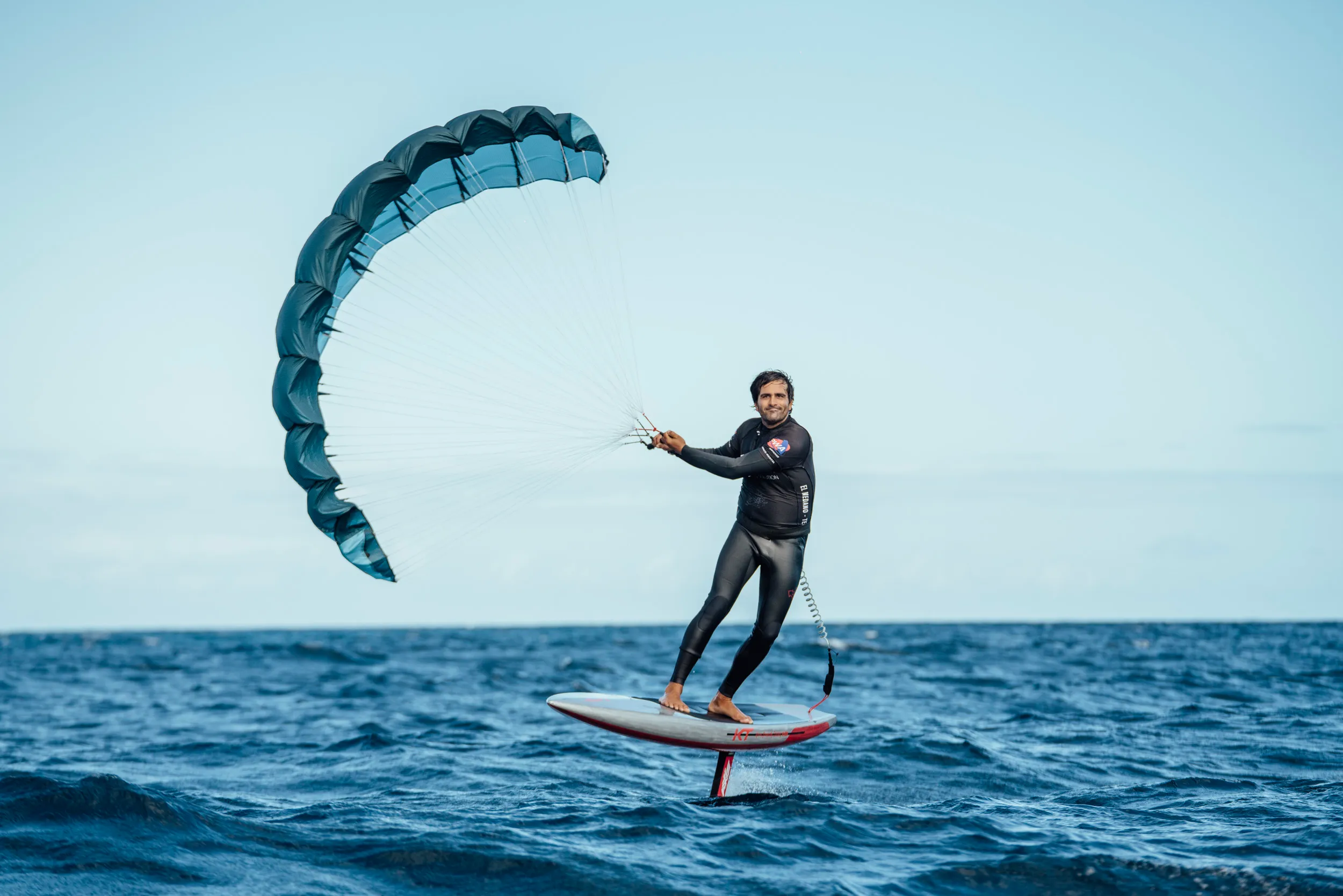
The Flysurfer POW and F-One Frigate represent two different philosophies applied to the same problem. Both are premium parawings. Both deliver exceptional upwind performance. Both come from brands with serious engineering credentials. But they solve for different things.
The POW is the wind range specialist: strongest low-end power, widest usable band per size, designed by a team with 20+ years of foil kite aerodynamics. The Frigate is the best all-rounder: most balanced performance across every metric, widest size selection, designed with premium materials from the paragliding industry.
This comparison helps you decide which philosophy fits your riding.
Specs at a Glance
| Flysurfer POW | F-One Frigate | |
|---|---|---|
| Sizes | 4 (1.7m to 5.0m) | 8 (1.9m to 6.5m) |
| Mid-size weight | 820g (4.0m) | 520g (4.0m) |
| Bar | 42cm carbon J-grip | 29cm or 41cm carbon |
| Bridle | Four sets, same colour, pulley on 4th | Three sets, colour-coded, pulley-free |
| Canopy | Nylon sailcloth | Porcher paragliding fabric |
| Harness line | Not included | Pre-attached (included) |
| Line length (4.0m) | 210cm | Standard |
| Wind range (4.0m) | ~14–24 kts | 16–25 kts (75kg) |
| Price (4.0m) | ~£700 / ~€750 / $799–$944 | £999 / €1,149 / $1,249 |
| Heritage | 20+ years foil kite design | Water sports (kite, wing), new to parawing |
Wind Range and Low-End Power
This is the POW’s headline advantage and the main reason riders choose it over the Frigate.
The POW generates noticeably stronger pull in marginal conditions compared to the Frigate at equivalent sizes. Riders describe staying on the water in wind that has other parawing users packing up. MACkite tested the 2.5m with a 90kg rider and found it usable from 22 to 30+ knots. The four-bridle pulley system maintains a consistent canopy profile as wind pressure changes, which is what gives the POW its wider effective band.
The Frigate has published wind ranges that overlap with the POW’s, but community feedback suggests the POW has a real edge at the bottom end. The Frigate compensates by offering sizes that the POW doesn’t: the 5.5m and 6.5m extend into light wind territory where the POW’s 5.0m may not be enough.
Verdict: POW has better low-end power per size. Frigate has larger sizes to compensate. If you’re choosing between equivalent sizes (e.g., both at 4.0m), the POW stays powered in lighter wind.
Upwind Performance
Both wings are among the best upwind performers in the category. The difference is in character.
The POW’s longer lines (210cm on the 4.0m) position the wing higher in the wind window, which translates directly into upwind angle. The Inertia described it as “bonkers fast upwind.” The four-bridle system keeps the canopy shape optimised for pointing ability throughout the power range.
The Frigate matches or nearly matches the POW’s upwind angles but feels more responsive to bar input. The Dynamic Bridle System is pulley-free, so feedback through the bar is direct and unfiltered. Riders who like to actively steer and trim will prefer the Frigate’s handling character.
Verdict: Both are top-tier upwind. POW has a slight edge on pure angle. Frigate offers more responsive control.
Weight and Packability
The Frigate is significantly lighter. A 4.0m Frigate weighs 520g (650g with bar). A 4.0m POW weighs 820g. That’s 300g of difference at the canopy level, and the POW’s longer 210cm lines add more weight on top.
For riders who prioritise pack size (travel, hiking to launch spots, stash-and-ride sessions), the Frigate is the better choice. The lighter weight also contributes to easier relaunch in very light wind, where a heavier canopy may struggle to inflate.
Verdict: Frigate wins on weight and packability.
Bridle System
This is where the two wings differ most in daily use.
The Frigate uses three colour-coded bridle sets (orange front, yellow centre, red rear) with no pulleys. Setup is fast: you can visually confirm correct rigging in seconds. Tangle sorting after crashes is straightforward because each line group is immediately identifiable.
The POW uses four bridle sets with a pulley mechanism on the fourth set. All lines are the same colour. The four-bridle system delivers the POW’s signature smooth power delivery and wide wind range, but it comes at a cost: setup takes longer, and untangling after crashes requires following each line individually.
If you’re new to parawings, the Frigate’s colour-coded system removes a significant friction point. If you’re experienced and value the performance advantages of the four-bridle system, the POW rewards the extra setup time.
Verdict: Frigate wins on setup ease. POW’s bridle system delivers performance advantages that justify the extra complexity for experienced riders.
Bar Design
The POW uses a single 42cm carbon J-shaped pistol grip for all sizes. The larger bar gives good control authority but can feel oversized for smaller wing sizes. Riders with smaller hands occasionally note this as a drawback.
The Frigate offers two bar sizes: 29cm for wings up to 4.0m and 41cm for 4.7m and above. The matched sizing means the bar always feels proportionate to the wing, and the smaller 29cm bar packs exceptionally compact.
Verdict: Frigate’s two-bar approach is better optimised. POW’s single bar is simpler but less refined.
Pricing
The POW is meaningfully cheaper than the Frigate at equivalent sizes.
| Size | Flysurfer POW | F-One Frigate |
|---|---|---|
| ~2.5m | ~£620 / €639 / $699–$839 | £870 / €999 / $1,099 |
| 4.0m | ~£700 / ~€750 / $799–$944 | £999 / €1,149 / $1,249 |
At the 4.0m size, you save roughly £300 / €400 / $300+ by choosing the POW. That’s significant, especially if you’re building a two-wing quiver.
Verdict: POW offers better value per wing. Frigate includes a harness line that the POW doesn’t, partially offsetting the difference.
Brand Heritage
Flysurfer has been designing foil kites since 2001. That’s 20+ years of single-skin canopy aerodynamics, including the Speed, Soul, and Sonic series that set benchmarks in the foil kite world. The POW is a natural extension of their core expertise.
F-One was founded in 1994 and is one of the largest kiteboarding brands globally. Their entry into parawingfoiling came in 2025 with the Frigate, designed by an external specialist. F-One brings enormous R&D resources and manufacturing quality, but they acknowledge being newer to this specific category.
Verdict: Flysurfer has deeper parawing-specific heritage. F-One has broader water sports credentials and bigger resources.
The Verdict
Choose the Flysurfer POW if:
- You ride in variable or marginal wind conditions and want the widest usable range from a single wing
- Low-end power is your priority (staying on the water when others can’t)
- You value upwind angles above all else
- You have foil kite experience and appreciate the familiar handling
- You want premium performance at a lower price than the Frigate
- You’re comfortable managing same-colour bridle lines
Choose the F-One Frigate if:
- You want the most balanced, complete all-round performance
- You need sizes larger than 5.0m for dedicated light wind riding
- You value fast, easy setup with colour-coded bridles
- You prefer lighter weight and better packability
- You want the pre-attached harness line and matched bar sizes
- You prioritise a responsive, active riding feel over maximum wind range
For most riders buying one premium wing to do everything, the Frigate is the safer choice. For riders whose conditions demand maximum wind range and low-end power, the POW delivers something no other parawing matches.
Related
- Flysurfer POW full review
- F-One Frigate full review
- Best parawings for 2026
- Parawing size guide
- Light wind parawingfoiling guide