Guide
Parawing Safety & Self-Rescue Guide: What Every Rider Needs to Know
Parawing foiling is one of the safer wind sports. There are no high-tension kite lines to cut you, no risk of being lofted 30 feet in the air, and the equipment is small enough to bundle up and swim home with. But “safer” doesn’t mean risk-free. You’re still on open water, powered by wind, standing on a hydrofoil with a sharp front wing. Things can and do go wrong.
This guide covers the real risks, what to do when problems happen, how to self-rescue, and the conditions and equipment checks that keep you safe.
Why Parawing foiling Is Safer Than Kiteboarding
Understanding what’s different helps you understand what risks remain. Compared to kiteboarding:
No high-tension lines at water level. Kite lines can cut skin and even wetsuit material. Parawing bridle lines are shorter, lighter, and don’t carry the same tension. The risk of line-related injuries is significantly lower.
No lofting risk. A kite can pull you into the air in a gust. A parawing can’t. The canopy is too small and the forces too low to lift a rider. The worst a gust will do is overpower you, which means faster speed or a fall into the water.
Small, packable equipment. If everything fails, you can bundle the entire parawing into a ball, tuck it under your arm, and paddle home. Try that with a 12m kite.
Shorter lines. Parawing lines are typically 2 to 4 metres long, compared to 20+ metres for a kite. Shorter lines mean less entanglement risk and faster recovery from tangles.
These advantages are real. They also create a false sense of security. The risks that remain are water-based risks: cold water, tides, distance from shore, equipment failure, and hydrofoil contact. These deserve respect.
The Real Risks
Hydrofoil Contact
The most common injury in parawing foiling is contact with the hydrofoil during a fall. The front wing of a foil is sharp, and when you fall off the board at speed, the board and foil can swing toward you. Cuts to feet, ankles, and shins are the most frequent injuries reported.
Mitigation: Wear an impact vest and consider a helmet, especially while learning. Some riders wear neoprene boots with reinforced soles. When you fall, try to fall away from the board (to the side or backward) rather than forward over the handlebars.
Cold Water and Hypothermia
Parawing foiling works in conditions as light as 10 knots, which often means spring and autumn sessions in cool water. Riding at foil speed creates wind chill. A 20-minute swim back to shore in 12°C water is a serious cold exposure risk.
Mitigation: Wear an appropriate wetsuit for the water temperature, not the air temperature. Carry a GPS tracker or phone in a waterproof pouch. Tell someone where you’re going and when you expect to be back.
Distance from Shore
Parawing foiling is efficient. You can cover a lot of ground quickly, especially downwind. It’s easy to end up further from shore than you intended. If the wind drops or your equipment fails, the swim back can be long.
Mitigation: Track your position relative to shore. Ride crosswind or upwind where possible, so that downwind drift takes you toward land, not away from it. Don’t ride offshore unless you have a safety plan.
Wind Dying Mid-Session
If the wind drops below the minimum for your wing size, you lose power. Unlike a kite, you can’t generate power by flying the wing through the wind window. When a parawing has no wind, it has no power. You’re on a board with no engine.
Mitigation: Check forecasts before every session. Watch for wind dropping, not just building. If conditions are marginal, stay close to shore. Know how to paddle your board.
What Happens When a Parawing Collapses
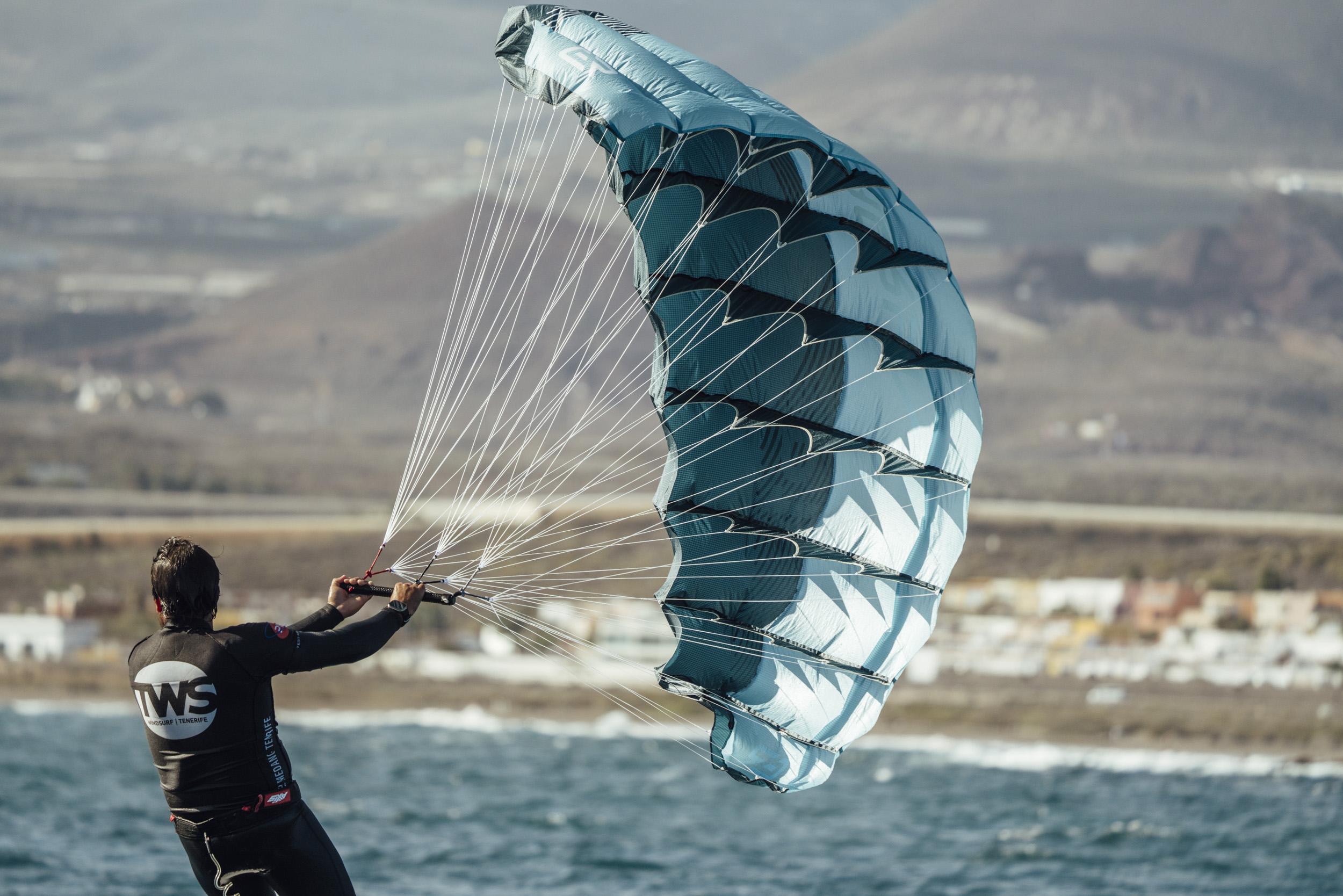
A canopy collapse is when part or all of the parawing folds inward, losing its inflated shape and therefore its lift. This is different from kiteboarding collapses (which can be violent) because parawing collapses are slower and lower-energy.
Why Collapses Happen
Wind lull. A sudden drop in wind pressure causes the canopy to partially deflate. The most common cause.
Turbulence. Riding downwind of obstacles (buildings, cliffs, trees) puts you in turbulent air that disrupts the canopy’s airflow.
Over-sheeting. Pulling the bar too far toward you stalls the wing, reducing airflow over the canopy and causing it to fold.
Wet canopy. Water on the canopy adds weight and disrupts airflow. Most parawings have water-resistant coatings, but a soaked wing in light wind can collapse.
How to Recover
Step 1: Release the bar. Let go or push the bar away from your body. This returns the wing to a neutral angle of attack, allowing air to refill the canopy. Most partial collapses recover on their own when you release bar pressure.
Step 2: Wait. Give the canopy 2 to 3 seconds to reinflate. Resist the urge to immediately pull the bar back in. Patience here prevents the most common follow-up mistake: re-stalling the wing while it’s trying to recover.
Step 3: Gradually re-engage. Once the canopy is fully inflated and stable overhead, slowly sheet in to rebuild power. Start gentle.
If the wing doesn’t recover: If you’re in the water with a fully collapsed canopy, gather the lines, spread the wing out on the water surface, and relaunch using the technique described below.
Brand Differences in Collapse Behaviour
Not all parawings handle collapses the same way.
Flow D-Wing: Uses a reflex airfoil design that virtually eliminates canopy collapse. The built-in geometric characteristic naturally resists folding. If collapse resistance is your top priority, the Flow D-Wing is the standout.
Ozone Pocket Rocket: Known for composed, predictable behaviour when overpowered. Collapses are clean and recovery is reliable. One of the best for newer riders.
F-One Frigate: Very stable even when heavily overpowered. Collapse behaviour is slightly less clean than the Pocket Rocket but recovery is straightforward.
Ensis Roger: The Depower Control System allows flying on front bridles only, which dramatically reduces power without collapsing the canopy. A useful safety feature in gusty conditions.
Self-Rescue: Getting Back to Shore
Self-rescue is the process of getting yourself and your equipment back to shore when you can’t ride. The good news: parawing self-rescue is much simpler than kite self-rescue because the equipment is small and light.
Step 1: Stop and Assess
Come off the foil. Sit or lie on your board. Take a moment to assess the situation: Where is shore? Which direction is the wind blowing? Is the wind likely to return? Are you drifting toward anything dangerous (rocks, shipping lanes)?
Step 2: Stow the Wing
If you can’t fly the wing (no wind, tangled lines, damaged canopy):
- Pull all the lines toward you, gathering the bridle
- Grab the canopy and bundle it into a ball
- Wrap the lines around the bundle to keep it secure
- Tuck the bundle under a strap on your harness or hold it against your body
A stowed parawing is roughly the size of a loaf of bread. It’s not going to interfere with paddling.
Step 3: Paddle
Lie on your board and paddle toward shore. If you have a larger foil board (80+ litres), this is straightforward. If you’re on a small downwind board, it’s harder but still manageable.
Paddle toward the closest safe landing point, not necessarily where you launched. Factor in wind drift and current.
Step 4: Signal for Help if Needed
If you can’t make it to shore under your own power:
- Whistle: Three short blasts is the international distress signal. Carry a whistle attached to your harness or PFD.
- Phone: A waterproof phone pouch lets you call for help. Save local coastguard and harbour numbers before you launch.
- GPS tracker: Devices like the Garmin inReach allow you to send an SOS with your exact location.
- Wave an arm: The universal “I need help” signal on water is one arm raised and lowered repeatedly.
Water Relaunch
When you crash and the wing lands in the water, you need to relaunch it. Our guide to getting started covers the basic technique. Here are the key points and some additional detail:
Basic Technique
- Gather the lines so the wing is close to you on the water surface
- Spread the canopy out so the leading edge faces into the wind
- Hold the bar with one hand and let the wind catch the leading edge
- Feed out the lines gradually as the wing inflates and lifts
- Once the wing is stable overhead, hook in and go
When Relaunch Is Difficult
Tangled lines. Don’t force it. Take the time to float and sort each line individually. Colour-coded bridle systems (Ozone, F-One) make this faster. Single-colour systems (Flysurfer POW) take longer.
Waterlogged canopy. In very light wind, a wet canopy may not have enough lift to relaunch. Try lifting the wing out of the water by holding it up with one hand while treading water or sitting on your board. Shake off excess water before attempting to relaunch.
No wind. If the wind has died completely, the wing won’t relaunch. Stow it and paddle.
Current or drift. If you’re drifting while trying to relaunch, prioritise getting the wing stowed and paddling. A failed relaunch attempt while drifting toward rocks or a harbour wall is worse than paddling with a stowed wing.
Pre-Session Safety Checklist
Run through this before every session:
Equipment checks:
- Bridle lines: no fraying, no tangles, all connections secure
- Bar: no cracks, grip intact, slides smoothly
- Harness line: no wear, correct length, catches the hook cleanly
- Harness: fits snugly, hook is clean and smooth, spreader bar slides freely
- Board and foil: all bolts tight, no damage to foil wings, mast secure
Conditions:
- Wind forecast checked (direction, strength, and when it’s expected to change)
- Tide state known (incoming, outgoing, slack)
- No offshore wind (or you have a plan for it)
- Water temperature assessed, appropriate wetsuit chosen
- You’ve identified a safe launch and landing spot
Communication:
- Someone knows where you’re going and when to expect you back
- Phone in a waterproof pouch or GPS tracker carried
- Whistle attached to harness or PFD
When NOT to Go Out
Knowing when to stay on shore is a more important safety skill than knowing how to self-rescue.
Offshore wind. Wind blowing from land to sea pushes you further out with every minute. If the wind drops, you have a long paddle against the current and residual chop. Offshore wind is the most dangerous condition for any wind sport.
Thunderstorms within range. Lightning on open water is lethal. If you can see lightning or hear thunder, don’t launch. If you’re already on the water, get to shore immediately.
Conditions beyond your skill level. There’s a difference between challenging yourself and putting yourself at risk. If the forecast shows winds above your comfortable range, or the water state is rougher than you’ve handled before, wait for a better day.
Riding alone in remote locations. If you’re the only person on the water and there’s no one on shore who can see you, the consequences of any equipment failure or injury multiply. Ride with others or choose a busy spot.
Failing equipment. If your lines are fraying, your bar has a crack, or your harness hook is corroded, fix it before you ride. Gear failures on the water turn minor problems into serious ones.
Recommended Safety Gear
Impact vest. Protects your torso from board and foil contact during falls. Not a life jacket (it won’t keep you afloat if unconscious), but valuable impact protection. Wear one every session.
Helmet. Protects against foil and board contact with your head. Particularly valuable while learning, when falls are more frequent and less controlled. Water sport helmets from Mystic, ION, and Gath are designed for this.
Whistle. Attach one to your harness or PFD. Three blasts is the universal distress signal. Costs almost nothing. Weighs almost nothing. Carries further than shouting.
GPS tracker or waterproof phone pouch. If you ride alone or in remote locations, being able to call for help or send an SOS is essential. A Garmin inReach or similar device provides satellite communication where phones have no signal.
Neoprene boots. Protect your feet from foil contact during falls and from rocks, shells, and debris when launching and landing. Reinforced soles add an extra layer between your feet and a sharp foil wing.
Appropriate wetsuit. Match the wetsuit to the water temperature. A 5/4mm suit in winter, 3/2mm in spring and autumn, and a shorty or rash vest in summer. Hypothermia is a slow, quiet risk that catches riders who dress for the air temperature rather than the water.
Frequently Asked Questions
Is parawing foiling dangerous?
Parawing foiling is one of the lower-risk wind sports. The main dangers are hydrofoil contact during falls, cold water exposure, and being caught far from shore. These risks are manageable with proper equipment, conditions awareness, and basic safety practices. Compared to kiteboarding, the lofting and high-tension line risks are eliminated entirely.
Do I need a life jacket?
An impact vest is recommended for every session. A full buoyancy aid or life jacket is worth considering if you ride alone, in cold water, or in areas with strong currents. If you’re a confident swimmer in warm, calm water close to shore, an impact vest alone is sufficient.
What should I do if my wing collapses?
Release the bar immediately. Let the canopy recover on its own for 2 to 3 seconds. Most partial collapses self-correct when you release pressure. If the wing doesn’t recover, gather the lines, spread the canopy on the water, and relaunch. See the collapse recovery section above for detailed steps.
How far from shore is too far?
A useful rule: never ride further from shore than you’re comfortable swimming. Factor in wind, current, and fatigue. If you’re wearing a 5mm wetsuit in cold water, your comfortable swimming distance is shorter than in a rash vest in the tropics.
Is parawing foiling safe for beginners?
Parawing foiling is best suited to riders who already have solid foiling skills. If you can foil confidently, the transition is manageable with appropriate precautions: start in steady wind of 15 to 25 knots, wear an impact vest and helmet, ride with others, and stay close to shore. Read our guide to getting started with parawing foiling for a full progression plan.
The Bottom Line
Parawing foiling removes the scariest risks from wind sports. No lofting, no high-tension lines, no equipment you can’t carry home. The risks that remain are water risks: cold, distance, current, and hydrofoil contact. These are manageable with the right equipment, awareness, and preparation.
Check your gear. Check the conditions. Tell someone where you’re going. Carry a whistle and a phone. And know when to stay on shore. Those five habits cover more safety ground than any amount of rescue technique.
For help choosing your first wing, see our best parawings for 2026 guide. To understand harness setup, read our harness and spreader bar guide. For a complete introduction to the sport, start with how to parawing foil.
Found this guide helpful?
Get new gear guides, honest reviews, and the best parawing deals straight to your inbox.