Guide
8 Beginner Mistakes in Parawing Foiling (And How to Avoid Them)
Every parawing foiler makes mistakes in the first few sessions. The learning curve is shorter than kiteboarding (see our introduction to parawing foiling if you’re completely new), but there are still pitfalls that waste time, damage gear, or put you in situations you’d rather avoid. Most of these mistakes come from habits carried over from other sports, assumptions that don’t apply to parawings, or simply rushing the process.
Here are the eight mistakes we see most often, and how to avoid them.
1. Buying Too Small a Wing for Your Conditions
The most common mistake, and the most expensive to fix. Riders coming from wingfoiling or kiteboarding often assume they need a similar-sized wing. They don’t. Parawings are lighter, less powerful per square metre, and rely on constant wind rather than active pumping. A 4.0m parawing does not generate the same power as a 4.0m inflatable wing.
What happens: You can’t get on foil. You spend the session floating, frustrated, and wondering what all the fuss is about.
How to avoid it: Use the wind range charts in our parawing size guide and be honest about your typical conditions. For most riders (70 to 85kg) in moderate wind (15 to 25 knots), a 4.0m to 5.0m is the sweet spot. If your local conditions are lighter (10 to 18 knots), you may need a 5.0m to 6.5m. When in doubt, size up. It’s easier to manage a slightly overpowered parawing than to will an underpowered one into generating lift.
2. Skipping Line Checks Before Launch
Walking the lines before every launch is the single most important pre-flight habit in parawing foiling. A tangled or crossed line changes the wing’s shape when it inflates, causing asymmetric launches, spirals, or collapses. With short line lengths, the check takes seconds, but skipping it is one of the most common causes of a poor or dangerous launch.
What happens: The wing launches unevenly, veers to one side, or collapses immediately. You crash before you reach the water. In the worst case, an out-of-control wing near other people or obstacles causes a collision.
How to avoid it: Every single session, walk each line from the bar to the wing. Run your fingers along the line to feel for twists, tangles, or knots. Check the bridle connections are clean and nothing is wrapped around the canopy fabric. This takes 30 seconds and prevents the most common launch failure. Our setup and rigging guide covers the full pre-flight checklist.
3. Launching in Offshore Wind
Offshore wind (blowing from land to sea) feels deceptively good on the beach: steady, clean, and laminar. The problem is that it pushes you further from shore with every second. If the wind drops, you’re stranded. If your equipment fails, you have a long paddle against the wind and chop.
What happens: You ride out easily, feel great for 20 minutes, then realise you’re 500 metres from shore with declining wind and no easy way back.
How to avoid it: Check the wind direction before every session. Cross-shore wind (parallel to the beach) is ideal for parawing foiling. Onshore wind works but can be gusty near the shore. Offshore wind should be avoided unless you have boat support, a group with safety cover, or extensive experience and a clear self-rescue plan. See our safety and self-rescue guide for more on conditions to avoid.
4. Not Learning Water Relaunch Before Going Deep
Crashes happen. The wing lands in the water. If you haven’t practised relaunching from the water surface, you’ll drift downwind while fumbling with tangled lines, watching the shore get further away.
What happens: You crash 200 metres out, can’t relaunch, spend 10 minutes sorting lines, drift another 100 metres downwind, eventually stow the wing and paddle back exhausted.
How to avoid it: Practise water relaunches in waist-deep water, close to shore, in your first few sessions. Crash intentionally. Land the wing on the water. Sort the lines. Relaunch. Repeat until it’s automatic. Our guide to getting started covers the relaunch technique. Some wings relaunch more easily than others: the Ozone Pocket Rocket and Ensis Roger are particularly reliable relaunchers.
5. Wrong Board Volume for Your Skill Level
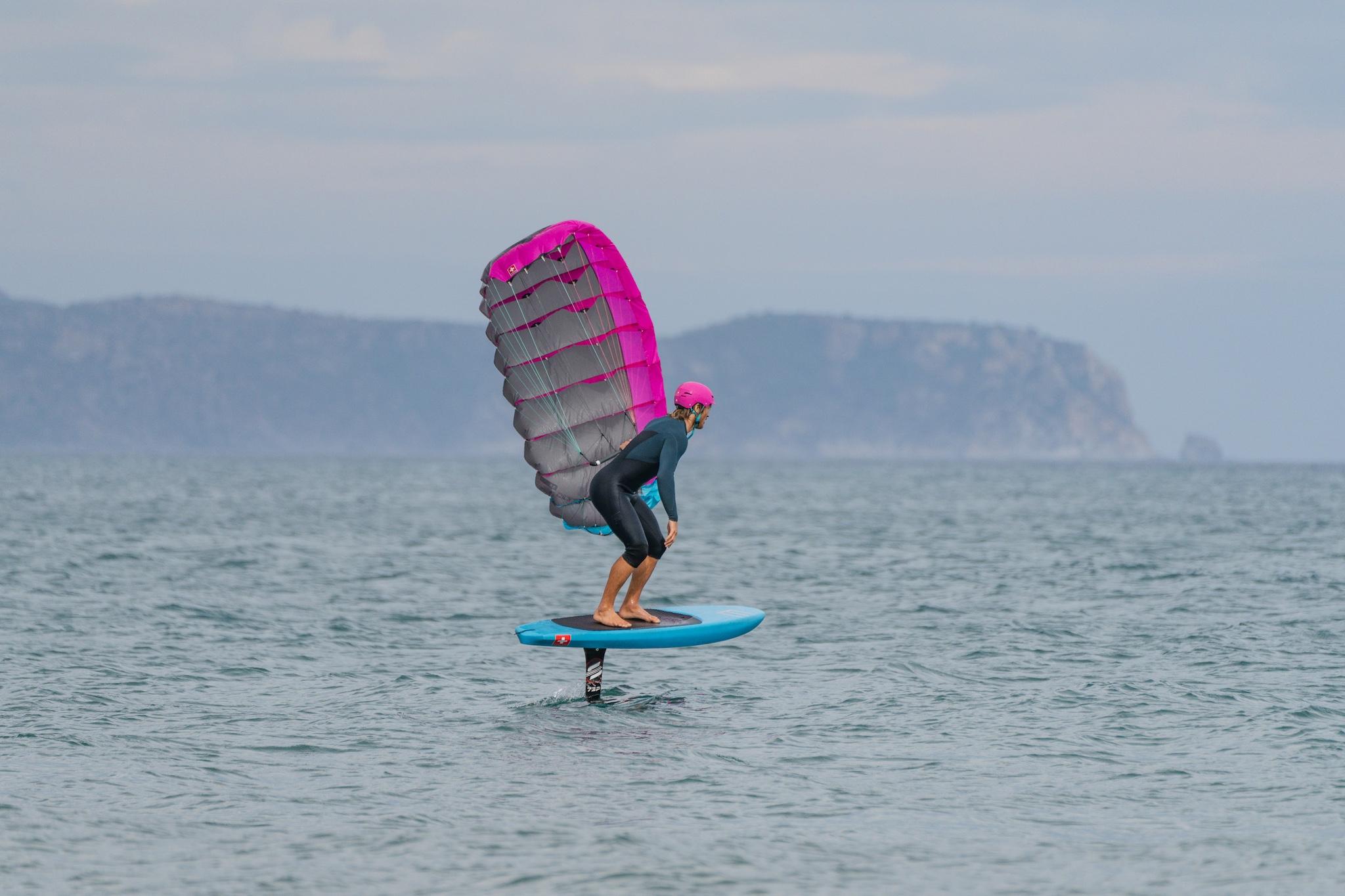
Experienced foilers on small, low-volume boards make it look easy. But starting parawing foiling on a compact 40-litre wing board makes everything harder: getting on foil takes more speed, balance during launch is precarious, and recovering from mistakes is less forgiving.
What happens: You can’t stand on the board comfortably while managing the parawing. You keep falling before reaching foiling speed. Every crash means a difficult deep-water start.
How to avoid it: Use the largest board you own for your first sessions. A board with volume roughly matching your body weight in kilograms (70 to 90 litres for most riders) gives you a stable platform to manage the parawing while building speed. You can move to a smaller board once the parawing management becomes automatic. See our best foil boards guide for recommendations.
6. Ignoring Canopy Maintenance
Parawings look simple: just fabric and lines. But that fabric is lightweight, UV-sensitive, and designed to precise aerodynamic tolerances. Salt, sand, UV exposure, and improper storage all degrade it faster than you’d expect.
What happens: Lines stiffen, the canopy loses its shape, small tears grow into big ones, and performance drops gradually enough that you don’t notice until it’s a problem.
How to avoid it: Rinse the wing with fresh water after every salt water session. Dry it before packing. Store it in a cool, dry, dark place. Inspect for damage regularly. Five minutes of care after each session extends the wing’s life by seasons. Our care and maintenance guide covers the full routine.
7. Trying to Ride Upwind Too Early
Going upwind is one of parawing foiling’s greatest strengths, and it’s tempting to start working upwind angles from session one. But upwind riding requires coordinating the wing angle, board trim, body position, and foil height simultaneously. If any one of those isn’t solid, you’ll crash.
What happens: You stall the foil trying to point too high. You oversteer the wing trying to redirect it. You fall repeatedly, eroding your confidence and making the sport feel harder than it is.
How to avoid it: Master straight-line foiling first. Get comfortable with the sensation of a parawing pulling you via the bar (or through a harness if using one) while you balance on a foil. Once straight-line runs feel natural (typically by session three or four), gradually introduce upwind angles. Small increments. The upwind ability will develop quickly once the fundamentals are solid. Our how to parawing foil guide walks through the progression.
8. Ignoring Brand-Specific Bridle Differences
Even if you walk the lines (see mistake #2), the bridle layout varies between brands. A check that works on one wing may miss a problem on another. Some wings use colour-coded bridle systems that make crossed lines obvious at a glance. Others use same-colour lines where a twist is harder to spot.
What happens: You check the main lines but miss a crossed bridle connection. The wing inflates asymmetrically, pulls to one side, and crashes.
How to avoid it: Learn your specific wing’s bridle layout. Wings from Ozone, F-One, Ensis, and Duotone use colour-coded systems that make pre-flight checks faster. Same-colour systems like the Flysurfer POW require more care. Read your wing’s manual for the recommended check sequence. See our setup and rigging guide for brand-specific tips.
The Pattern
Most of these mistakes share a root cause: rushing. Rushing to buy gear without checking sizing. Rushing to the water without checking the setup. Rushing to go upwind before mastering straight lines. Rushing past the line check before launch.
Parawing foiling rewards patience. The setup is fast (3 to 5 minutes). The learning curve is short (5 sessions for competent riders). The sessions are long (2+ hours without arm fatigue). There’s no reason to rush any of it.
The Bottom Line
Every mistake on this list is avoidable with basic preparation and a willingness to slow down. Check your gear. Check the conditions. Check your lines. Start with the right size wing and the right size board. Learn relaunch before you need it. Maintain your equipment. Build skills in order.
If you’re just getting started, our complete guide to parawing foiling walks through the full progression. For help choosing your first wing, see our best parawings for 2026 guide. For harness setup, read the harness and spreader bar guide. For conditions and safety, check the safety and self-rescue guide.
Found this guide helpful?
Get new gear guides, honest reviews, and the best parawing deals straight to your inbox.