Duotone Review
Duotone Stash Parawing Review: Full Guide for 2026
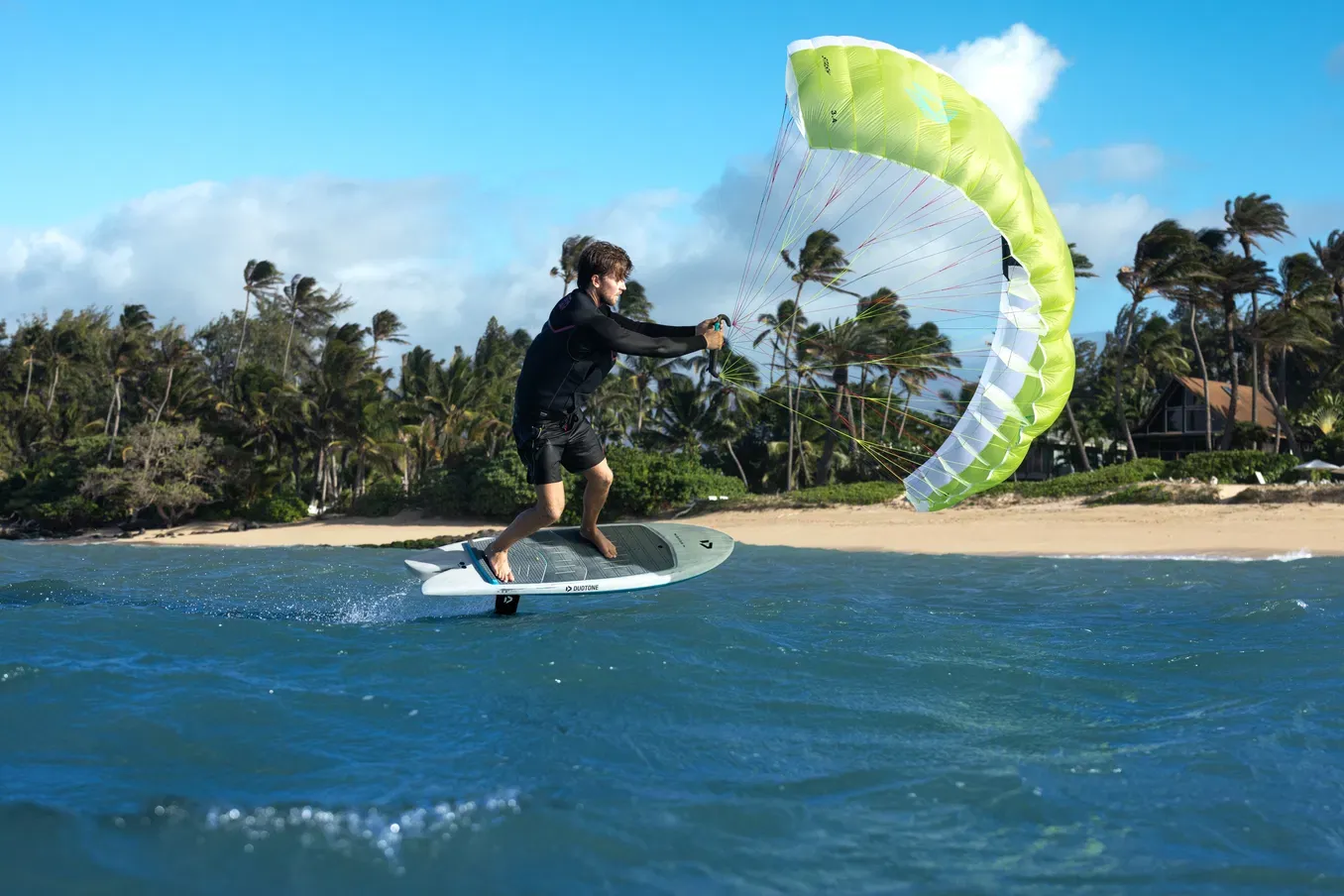
Duotone is one of the biggest names in water sports, and their entry into the parawing market was always going to carry weight. The Stash is their first parawing, now in its second generation (V2 for 2026), bringing a hybrid single-skin design with double-skin wingtips that takes a genuinely different engineering approach to a category still dominated by pure single-skin canopies.
This guide covers the full Duotone Stash range: what the V2 brings over the original, how the hybrid construction works in practice, and whether it deserves a place on your shortlist. We’ve gathered specs, community feedback, and an honest assessment of where Duotone sits in the current market.
About Duotone
Duotone (formerly North Kiteboarding) is one of the most established brands in the wind sports industry. They produce kites, wings, boards, and foils, with a global dealer network that few brands in parawingfoiling can match. Their experience spans decades of aerodynamic design, materials science, and rider-focused product development.
The Stash was developed by Ken Winner, a highly regarded designer in the kite and paraglider world, in collaboration with downwind foiling experts Finn and Jeffrey Spencer. Winner’s background in lightweight canopy design is directly relevant to parawing engineering, and his involvement gives the Stash credibility that goes beyond Duotone’s brand name alone.
When Duotone entered the parawing market, they had the engineering depth, supply chain, and global distribution to move quickly. The V2 shows they’re committed to iterating based on real rider feedback rather than resting on a first attempt.
The Duotone Stash V2 (2026)
The Stash V2 is a significant update over the 2025 original. Duotone describe it as delivering “a completely new level of flying stability, power, upwind, depower and overall riding comfort.” The core hybrid concept remains: a single-skin canopy with double-skin wingtips, combining the packability of a single-skin with the stability of pressurised tips.
| Size | Wind Range (knots) | Weight | Wingspan | Handle |
|---|---|---|---|---|
| 2.2m | 26-39 | TBC | 199cm | 35cm carbon |
| 2.8m | 22-34 | 585g | 213cm | 35cm carbon |
| 3.4m | 18-29 | 634g | 235cm | 35cm carbon |
| 4.0m | 15-25 | 693g | 254cm | 35cm carbon |
| 4.8m | 12-21 | 752g | 278cm | 35cm carbon |
| 5.6m | 10-18 | 809g | 301cm | 35cm carbon |
Construction: Ultra-lightweight 30g paragliding ripstop canopy, segmented stabilised leading edge, upgraded sheathed lines with low-tangle coating, ergonomic carbon handle.
Available colours: Lime/White, White/Black, Purple/Dark Grey
What Changed from V1 to V2
The 2026 Stash addresses the main criticisms of the original. Key improvements include:
New aspect ratio and arc. The V2 uses a higher-aspect canopy with a revised arc that significantly improves upwind angles. Early feedback from testing in Dakhla, Morocco describes the V2 as sitting “forward in the window” and pulling efficiently without feeling aggressive.
Improved depower. The new handle design allows hand placement under the A-lines, giving riders more control over power management. The leading-edge bridle triangle maintains a positive angle during depower, which keeps the canopy stable when you sheet out.
Better line behaviour. Duotone tested multiple line stiffness options and settled on upgraded sheathed lines with a low-tangle coating. Riders testing the V2 reported significantly fewer mid-session tangles than both the V1 and competing parawings.
Segmented leading edge. The stabilised leading edge uses a segmented profile design that reduces drag and improves canopy shape consistency across the wind range.
How the Stash Flies
The V2 has drawn noticeably more positive feedback than the original. Testers describe the canopy as settled and predictable, holding its shape cleanly with no tendency to fold, surge, or behave unpredictably when the wind shifts.
Upwind performance is a clear step forward from the V1. The higher-aspect canopy and clean profile let the wing sit forward in the window and pull efficiently. It’s not quite at Ozone Pocket Rocket levels of upwind ability, but the gap has narrowed considerably.
The hybrid construction produces a different feel to pure single-skin designs. The double-skin wingtips add lateral stability, which is most noticeable in gusty conditions where the tips maintain their shape rather than fluttering. The trade-off is marginally more weight and pack size compared to the lightest pure single-skin options from BRM.
Stash and deploy speed is good. The 35cm carbon handle is ergonomic and the bridle system, while more complex than a pure single-skin, manages well in practice thanks to the three-way colour coding (main canopy, leading edge panels, and line rows).
Pros and Cons
Pros:
- Hybrid single-skin/double-skin tip construction adds real stability
- Ultra-lightweight 30g paragliding ripstop canopy
- Published wind ranges for every size, removing guesswork from sizing
- Designed by Ken Winner, a respected name in kite and paraglider design
- V2 significantly improves upwind, depower, and line tangle resistance
- Duotone’s global dealer network makes it easy to find, buy, and get support
- Three-way colour coding simplifies setup and relaunch
- Six sizes from 2.2m to 5.6m covers a broad range of conditions
Cons:
- Hybrid construction adds some weight compared to pure single-skin designs (a 4.0m Stash at 693g vs a 4.0m BRM Kanaha at 464g)
- The Inertia testing noted instability when heavily powered and centre-line connection shifting unintentionally
- Less community feedback history than BRM or Ozone, though the V2 is building a stronger base
- Marginally larger pack size than the most compact competitors
Community Feedback
The V2 has generated significantly more positive feedback than the original Stash. Riders who tested it in Dakhla ahead of the 2026 launch describe the canopy as “settled” and “predictable,” with clean power delivery and noticeably improved upwind angles.
The most consistent praise centres on the balance between stability and ease of use. One tester described the Stash as “a good middle-of-the-road wing” that’s “relatively easy to fly, with good range and stability.” That combination of accessibility and competence is what makes the Stash appealing to riders who want a capable parawing without the learning curve of more performance-focused designs.
Line tangle resistance is another recurring positive for the V2. Duotone’s upgraded sheathed lines with low-tangle coating have measurably reduced one of the most common frustrations in parawingfoiling. Multiple riders noted fewer tangles compared to both the V1 and other brands they’d tested.
The most common criticism relates to behaviour at the extreme ends of the power range. The Inertia’s comprehensive parawing test noted instability when the Stash is heavily powered, and a centre-line connection that can shift unintentionally. This is more of a concern for aggressive riders pushing the wing hard in strong wind than for typical recreational use.
First-time parawing riders report that the Stash is approachable. One Seabreeze forum user described getting up to 38 km/h on their first session with the 4.0m, noting it was “actually easier to start with a parawing” compared to a regular wing. They did flag that without a stash belt, waves kept washing the wing off the board and lines kept tangling.
Pricing
| Size | Price (EUR) | Price (USD) |
|---|---|---|
| 2.2m | €919 | $886 |
| 2.8m | €939 | $908 |
| 3.4m | €959 | $931 |
| 4.0m | €979 | $954 |
| 4.8m | €999 | $977 |
| 5.6m | €1,019 | $999 |
GBP pricing varies by retailer. UK shops such as Worthing Watersports, The Watersports Centre, and Poole Harbour Watersports all stock the Stash. Check with your local Duotone dealer for current GBP pricing.
How Does Duotone Compare to BRM?
Duotone and BRM approach parawing design from very different directions. BRM is the pioneer with ultra-lightweight, highly packable wings and the deepest model range (four models). Duotone brings the engineering resources and global distribution of one of the world’s largest water sports brands.
Choose Duotone if: You want easy availability through a massive dealer network, published wind ranges to guide sizing, a stable hybrid design, and the reassurance of a well-established brand with proven after-sales support. The Stash is also a strong choice if reduced line tangling is a priority.
Choose BRM if: You want the lightest, most packable parawings available, the deepest range of specialised models, and the heritage of the brand that created the sport. BRM’s Kanaha at 464g (4.0m) is significantly lighter than the Stash’s 693g.
How Does Duotone Compare to Ozone?
Duotone and Ozone both come from backgrounds where aerodynamic engineering is central to the business. Both produce premium parawings with published wind ranges and strong dealer networks.
Choose Duotone if: You value the hybrid construction’s stability benefits, want the broadest dealer network in water sports, and prefer the V2’s low-tangle line system. The Stash is also slightly more affordable than the Pocket Rocket at most sizes.
Choose Ozone if: You prioritise upwind performance above all else. The Pocket Rocket consistently rates as one of the best upwind performers in the market, with reliable water relaunch. Ozone’s 25+ years of paraglider heritage also gives them deeper canopy design experience.
How Does Duotone Compare to Gong?
Duotone and Gong sit at different price points with different strengths. Gong’s Lowkite is the accessible entry point to parawingfoiling, while the Stash sits in the mid-to-premium range with more sophisticated engineering.
Choose Duotone if: You want a more refined design with hybrid stability, published wind ranges, and the backing of a global brand with dealer support in most countries. You’re willing to pay more for better depower and line management.
Choose Gong if: You want the most affordable entry into parawingfoiling, straightforward purchasing from Europe, and a proven single-skin design that delivers strong value. Gong is the clear choice for budget-conscious first-time buyers.
Where to Buy the Duotone Stash
Duotone’s dealer network is one of the most extensive in water sports. This is a genuine practical advantage: you can see, handle, and buy the Stash locally in most countries, with local warranty and support.
UK dealers:
- Worthing Watersports (worthingwatersports.com)
- The Watersports Centre (thewatersportscentre.com)
- Poole Harbour Watersports (pooleharbour.co.uk)
- Hydrofoil Store (hydrofoilstore.com)
- Wake Style (wake-style.com)
US dealers:
- MACkite Boardsports (mackiteboarding.com)
- Big Winds (bigwinds.com)
- Pacific North Sports (pacificnorthsports.com)
- Kiteboarding Closeouts (kiteboardingcloseouts.com)
EU: Available through Duotone’s European dealer network. Check duotonesports.com for your nearest stockist. Surfpirates (surfpirates.de) stocks the full range in Germany.
AU: Check Duotone’s Australian distributors via duotonesports.com.
Frequently Asked Questions
Is the Duotone Stash good for beginners?
The Stash is one of the more approachable parawings on the market. The stable canopy, smooth power delivery, and published wind ranges make it easier to choose the right size and get started. The V2’s improved line management also reduces one of the biggest frustrations for new riders. That said, if budget is the primary concern, the Gong Lowkite offers a lower entry price.
What’s the difference between the Duotone Stash V1 and V2?
The V2 (2026) is a significant upgrade. Key changes include a higher-aspect canopy for better upwind, improved depower through a redesigned handle and bridle geometry, upgraded sheathed lines with low-tangle coating, and a segmented stabilised leading edge. The hybrid single-skin/double-skin tip concept carries over, but the execution is noticeably more refined.
What size Duotone Stash should I get?
Duotone publishes wind ranges for each size, which makes this easier than with brands that don’t. For a rider in the 70 to 85kg range in moderate conditions (12 to 25 knots), the 4.0m to 5.6m sizes will cover most sessions. For stronger wind or lighter riders, look at the 2.8m to 4.0m range. See our parawing size guide for a detailed breakdown across all brands.
How does the Duotone Stash compare to BRM?
BRM leads on weight and packability with four specialised models. Duotone leads on dealer accessibility, published wind ranges, and the unique hybrid construction. The Stash is heavier than equivalent BRM models but offers a different stability profile from the double-skin wingtips. Both are premium options; the choice depends on whether you prioritise packability (BRM) or accessibility and stability (Duotone).
The Verdict
The Stash V2 represents a genuine step forward for Duotone’s parawing programme. The improvements to upwind performance, depower, and line management address the main criticisms of the original, and the hybrid construction continues to offer a meaningfully different stability profile from pure single-skin designs.
Duotone’s biggest advantage remains accessibility. Their global dealer network means you can buy the Stash locally, with local support, in more countries than any other parawing brand. Combined with published wind ranges for every size, the Stash removes much of the guesswork from choosing and buying a parawing.
The trade-off is weight and pack size. At 693g for a 4.0m, the Stash is significantly heavier than BRM’s equivalent (464g). If ultra-light packability is your priority, BRM still leads. But if you want a well-engineered, stable parawing backed by one of the world’s largest water sports brands, the Stash V2 makes a compelling case.
Head-to-Head Comparisons
- BRM Ka’a vs Duotone Stash: ultra-light specialist vs global mainstream
More on Duotone
Our brand overview covers Duotone's history, full product range, and where to buy.
Read the Duotone brand overview