Flow Paragliders Review
Flow D-Wing Parawing Review: Full Guide for 2026
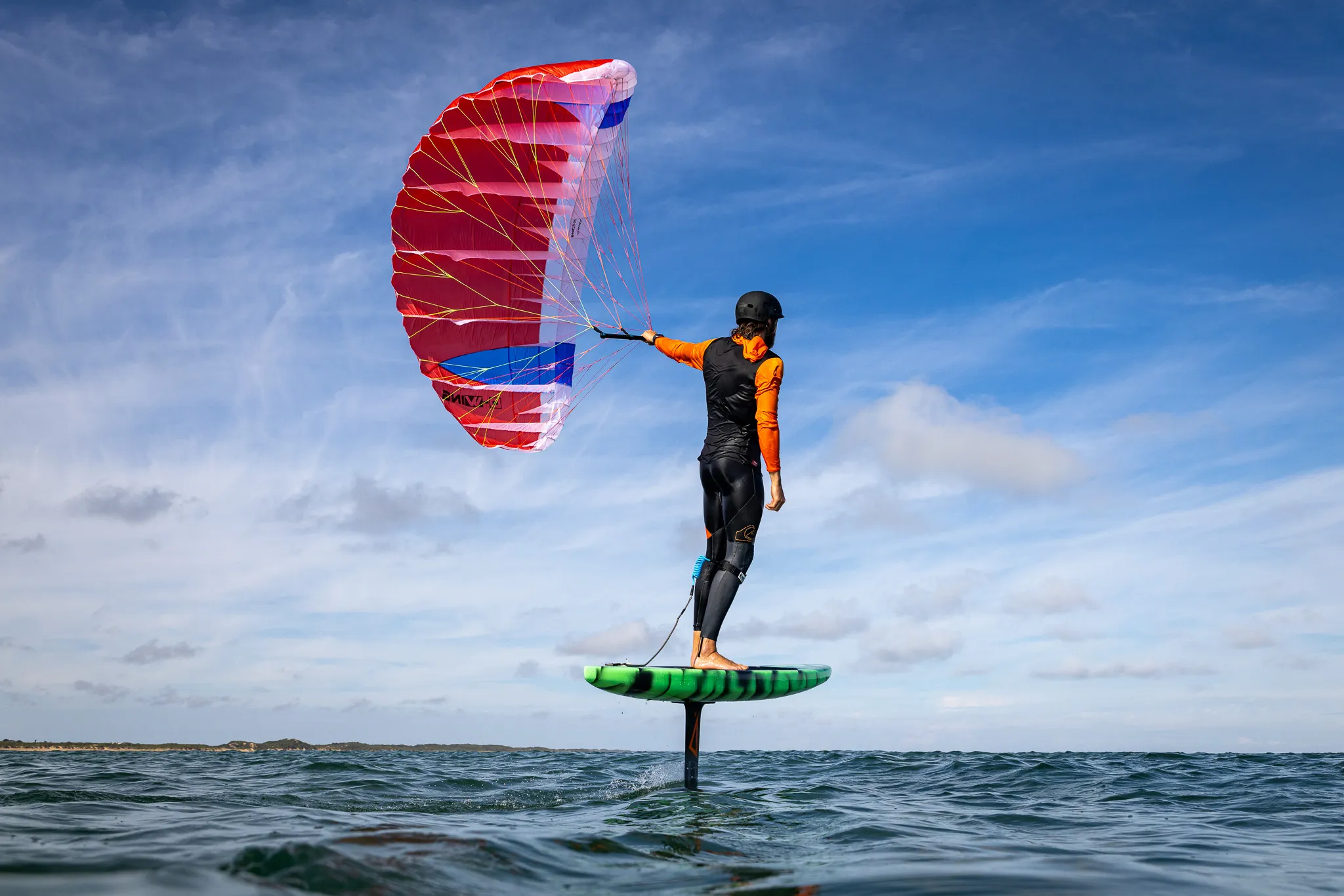
Flow Paragliders bring a genuinely unique design philosophy to the parawing market. Their D-Wing uses a reflex airfoil that virtually eliminates the risk of canopy collapse, a feature that no other parawing brand currently offers. For riders who prioritise stability and safety above all else, this is a significant engineering differentiator built on decades of paraglider design expertise.
This guide covers the D-Wing V2: what the reflex airfoil actually does, how the wing handles on the water, what the community thinks, and whether it belongs on your shortlist.
About Flow Paragliders
Flow Paragliders is an Australian company with deep roots in paraglider design. Their expertise in reflex airfoil technology was originally developed for powered paragliders, where canopy stability and collapse resistance are critical safety requirements. That heritage translates directly into parawing design: building a canopy that stays stable even when fully depowered is a genuinely specialised skill, and Flow’s background gives them a meaningful advantage.
Flow’s RPM paraglider (their cross-country full reflex wing) demonstrates the maturity of their reflex technology. The D-Wing applies the same principles to a much smaller, water-based application, but the underlying engineering is the same: a canopy profile that naturally resists collapse.
The Flow D-Wing V2
The D-Wing V2 comes in seven sizes, though not all are currently available. The 3.0m, 3.7m, and 4.2m are the core range, with the 1.8m, 2.5m, 5.1m, and 5.8m listed as coming soon.
| Size | Wind Range (knots) | Weight | Cells | Projected AR | Wingspan |
|---|---|---|---|---|---|
| 1.8m | TBC | 400g | 19 | 2.11 | TBC |
| 2.5m | 20-35 | 500g | 19 | 2.11 | 2.48m |
| 3.0m | 20-30 | 600g | 19 | 2.15 | 2.87m |
| 3.7m | 16-28 | 700g | 19 | 2.15 | 3.39m |
| 4.2m | 15-25 | 700g | 21 | 2.15 | 3.42m |
| 5.1m | TBC | 750g | 21 | 1.91 | TBC |
| 5.8m | TBC | 800g | 21 | 1.87 | TBC |
Construction: Porcher Skytex 32g ripstop canopy, Liros Technora lines, full carbon fibre bar with floating B-attachment point, colour-coded lines with split A-lines for stow/relaunch identification.
Line length: Approximately arm-length (shorter than most competitors), which improves packability.
Included: D-Wing V2, harness line, Flow Parawing Bag. Optional Stash Belt V2 available separately.
The Reflex Airfoil: What It Actually Does
The reflex airfoil is Flow’s defining feature and the main reason to consider the D-Wing over other parawings. Here’s what it means in practical terms.
A standard parawing canopy can collapse (deflate) if the angle of attack becomes too steep or the wing is caught by a sudden gust. When this happens, part or all of the canopy folds, you lose power, and the recovery can be disorienting. This is one of the biggest confidence challenges for riders learning to parawing.
Flow’s reflex airfoil maintains its shape even when fully depowered. The canopy profile has a built-in geometric characteristic that naturally resists collapse. You can sheet out completely, fly on front lines only, and the wing holds its shape. In gusty conditions, this means dramatically fewer unexpected collapses and a wider safety margin.
The practical benefit extends to upwind riding. Because the canopy stays stable across a broader angle-of-attack range, riders can push higher upwind angles without the canopy folding. Flow claims this produces “enhanced upwind ability in both underpowered and overpowered conditions.”
The technology also improves turning and gybing. With a canopy that doesn’t collapse unexpectedly, transitions are smoother and more predictable. Riders consistently report fewer falls during manoeuvres.

How the D-Wing Flies
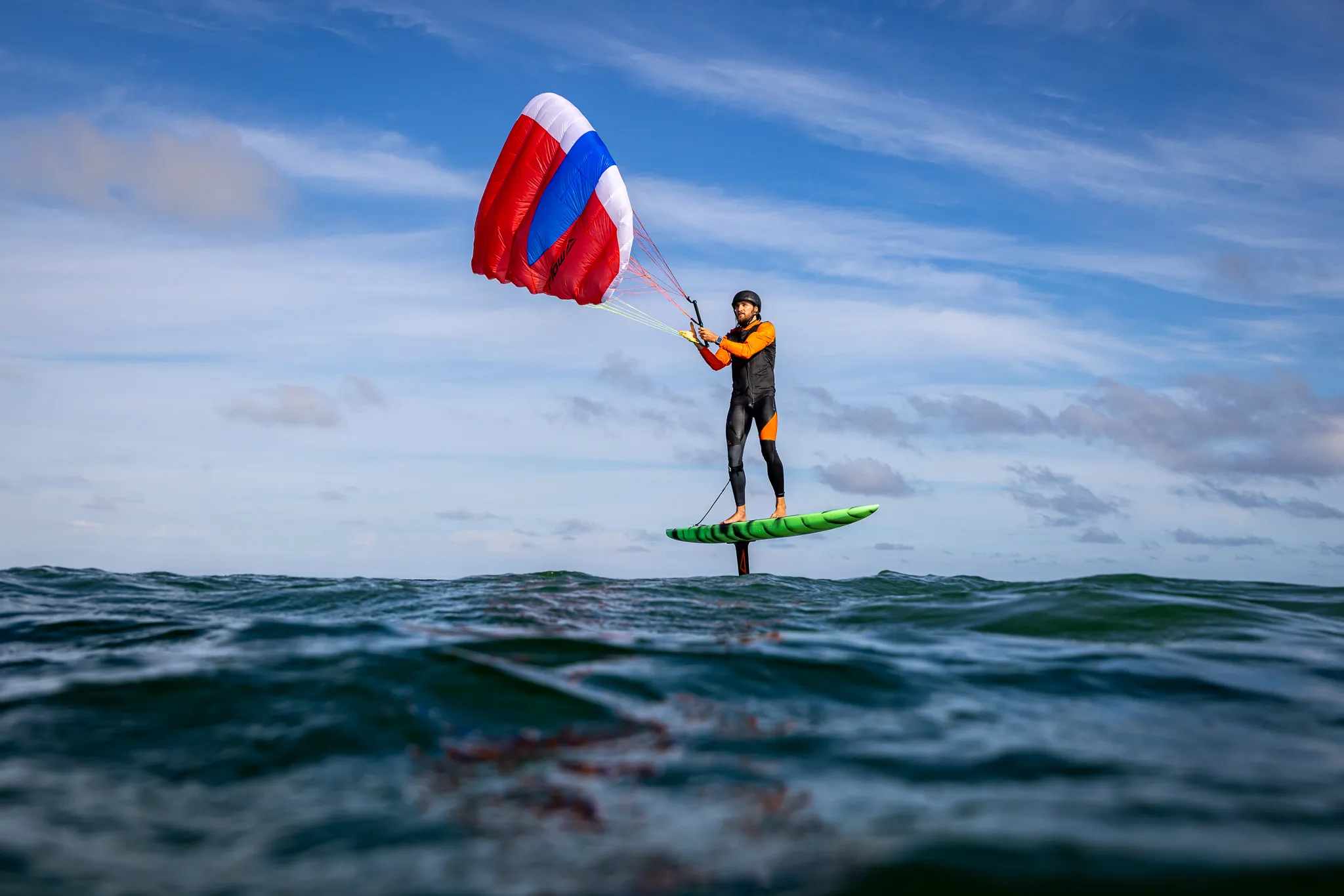
Community feedback paints a picture of a wing that’s exceptionally stable once you’re up and riding. Once on foil with apparent wind, the D-Wing is described as “soooo stable and intuitive.” The reflex airfoil delivers on its promise: the canopy holds its shape, responds predictably, and doesn’t produce the sudden collapses that can happen with other designs.
Ground handling is straightforward. The wing launches easily when dry and flies well on front lines, dropping power quickly when pressure is applied to the rear lines. The colour-coded line groups (three distinct colours for front, mid, and back) and a coloured leading edge make sorting after a crash significantly faster than with unmarked parawings.
The carbon bar features a floating B-attachment point, which allows the back hand to move freely along the bar rather than being locked into a fixed position. This is a subtle but meaningful ergonomic improvement that gives riders more control options.
One reviewer noted “incredibly fast progress” compared to traditional wing foiling, going from initial foiling to performing gybes and relaunches within four sessions.
The main limitation that community feedback highlights is the usable wind range. Several riders note that at the lower end (18 to 20 knots for a 3.0m), it can be difficult to generate enough power to get up on foil. At the upper end (25+ knots), the only way to fully depower is to stow the canopy. One Foil Exchange reviewer described the usable range as “very small.” This is a common challenge across all parawings, but it’s worth calibrating expectations: the D-Wing’s stability comes partly from a design that prioritises safety over raw power.
Pros and Cons
Pros:
- Reflex airfoil virtually eliminates canopy collapse, a genuine safety advantage
- Exceptional stability once on foil
- Premium materials: Porcher Skytex canopy, Liros Technora lines, full carbon bar
- Colour-coded line groups save significant time during relaunch
- Floating B-attachment point on the bar gives more control flexibility
- Shorter arm-length lines improve packability
- Paraglider engineering heritage with deep canopy design expertise
- Smoother, more predictable turning and gybing
- Competitive pricing, especially for the materials quality
Cons:
- Usable wind range described as narrow by some riders
- The Inertia noted wingtip folding when overpowered
- Australian-based brand with limited European dealer presence
- Smaller community knowledge base compared to BRM or Ozone
- Not all seven sizes are currently available (four in production, three coming soon)
- Crashes still produce tangled lines (true of all parawings, but noted by reviewers)
Community Feedback
The D-Wing has generated genuine interest in the parawing community, particularly among riders who value stability and safety. The reflex airfoil consistently draws praise for delivering on its core promise: a canopy that doesn’t collapse.
In The Inertia’s comprehensive parawing test, the D-Wing was rated “Solid All-Rounder” with praise for its durable construction and balanced performance across the wind range. They noted wingtip folding when overpowered as the main limitation. The regular retail price was listed at $869 USD, making it one of the more competitively priced options for the materials quality on offer.
The Foil Exchange review provides the most detailed user perspective. A rider with four sessions on the 4.2m described the D-Wing as “very different to a wing” and “a lot easier than a wing” for getting started. The stability when riding with apparent wind earned particular praise. The same reviewer flagged the narrow usable wind range and the frustration of crashes (tangled lines are “a lot more frustrating than with wings”).
In a back-to-back comparison between the Ensis Roger 3.0m and the Flow D-Wing 3.0m on foilers-community.com, the D-Wing was noted for its stability advantages and the reflex airfoil’s contribution to rider confidence. The Ensis Roger was praised for user-friendliness and intuitive handling, suggesting the two brands appeal to different priorities.
Pricing
| Size | Price (AUD) | Price (USD) |
|---|---|---|
| 2.5m | A$1,200 | ~$760 |
| 3.0m | A$1,380 | ~$875 |
| 3.7m | A$1,380 | ~$875 |
| 4.2m | A$1,400 | ~$890 |
| 5.5m | A$1,450 | ~$920 |
US pricing at MACkite is currently listed at $599 on sale (regular $859). Check with dealers for current pricing as promotional pricing varies.
GBP and EUR pricing is less widely available due to Flow’s Australian base. European and UK buyers should check directly with dealers that carry Flow products or order via Flow’s website with international shipping.
How Does Flow Compare to BRM?
Flow and BRM represent very different design philosophies. BRM prioritises ultra-lightweight construction and packability. Flow prioritises canopy stability through reflex airfoil technology.
Choose Flow if: You want the most collapse-resistant canopy available, value premium materials (Porcher Skytex, Liros Technora), and prioritise stability and safety over minimum weight. The D-Wing is a strong choice for riders who find canopy collapses unsettling.
Choose BRM if: You want the lightest, most packable parawings, the deepest model range, and the heritage of the brand that created the sport. BRM’s wings are significantly lighter and more compact.
How Does Flow Compare to Ozone?
Both brands come from paraglider backgrounds, giving them genuine canopy design expertise. Ozone has deeper heritage (25+ years) and a larger rider community. Flow offers a unique stability advantage through reflex airfoil technology.
Choose Flow if: You prioritise canopy stability and collapse resistance above all else. The reflex airfoil gives the D-Wing a safety advantage that Ozone’s Pocket Rocket doesn’t match. If unexpected collapses are your biggest concern, Flow is the strongest option.
Choose Ozone if: You want the best upwind performance, reliable water relaunch, and the choice between two distinct models (Pocket Rocket for all-round, PowerPack for stash-and-glide). Ozone has a larger community and more rider feedback available.
How Does Flow Compare to Gong?
Flow and Gong sit at different price points. Gong’s Lowkite is the accessible entry point; Flow’s D-Wing offers premium materials and the unique reflex airfoil at a moderate price premium.
Choose Flow if: You want a genuinely different design approach with collapse resistance, premium materials, and the confidence of a canopy that won’t unexpectedly fold. Worth the premium if stability is your main concern.
Choose Gong if: You want the most affordable entry into parawingfoiling. Gong’s Lowkite is proven, straightforward, and excellent value. The right choice for budget-conscious first-time buyers.
Where to Buy the Flow D-Wing
Flow Paragliders is Australian-based, so the purchasing experience differs depending on your region.
AU: Direct from Flow Paragliders (flowparagliders.com.au)
US dealers:
- MACkite Boardsports (mackiteboarding.com)
- Windance (windance.com)
- Hatteras Island Surf Shop (hatterasislandsurfshop.com)
- Surf Plus Watersports (surfpluswatersports.com)
- Wing and Kite (wingandkite.com)
- Paka’a Foil Hawaii (pakaafoilhawaii.com)
EU: The Foil Shop (thefoilshop.fr) in France, Wake Style (wake-style.com)
UK: Limited dealer presence. International shipping from the US or Australian dealers is the most common route for UK buyers. Factor in delivery times and potential customs duties.
Frequently Asked Questions
What is a reflex airfoil and why does it matter?
A reflex airfoil is a canopy profile designed to maintain its shape even when fully depowered. This virtually eliminates canopy collapse (deflation), which is one of the most common and unsettling things that can happen during parawingfoiling. Flow developed this technology for powered paragliders, where collapse resistance is a critical safety requirement. The D-Wing applies the same engineering to parawingfoiling.
Is the Flow D-Wing good for beginners?
The D-Wing’s collapse-resistant design makes it one of the safest canopies available, which is appealing for newer riders. The stability and predictable handling help build confidence quickly. One reviewer went from first session to gybes within four sessions. That said, if budget is a factor, the Gong Lowkite offers a lower entry price.
How does the Flow D-Wing compare to Ozone?
Both brands come from paraglider backgrounds. Ozone’s Pocket Rocket leads on upwind performance and has a larger rider community. Flow’s D-Wing offers superior canopy stability through reflex airfoil technology. Choose based on whether you prioritise upwind speed (Ozone) or canopy stability (Flow).
What size Flow D-Wing should I get?
For a rider in the 70 to 85kg range in moderate conditions (15 to 25 knots), the 3.7m or 4.2m will cover most sessions. For stronger wind, the 3.0m is the versatile option. The 5.5m is for light wind. Be aware that several reviewers note the usable wind range per size is narrower than some competitors, so consider owning two sizes if your conditions vary significantly. See our parawing size guide for a full breakdown by rider weight.
The Verdict
The Flow D-Wing occupies a unique position in the parawing market. The reflex airfoil is a genuine differentiator that delivers measurable stability and safety advantages. No other parawing brand offers the same level of collapse resistance, and for riders who find unexpected canopy collapses unsettling or dangerous, this single feature can be reason enough to choose Flow.
The premium materials (Porcher Skytex, Liros Technora, full carbon bar) match the engineering quality, and the arm-length lines keep packability competitive despite the more complex airfoil design. The colour-coded line system is practical and well-executed.
The trade-off is a narrower usable wind range per size and limited dealer presence outside of the US and Australia. Flow is an Australian company without the global distribution networks of Duotone or Ozone, which means buying and support can require more effort depending on where you’re based.
If stability is your priority, the D-Wing is the strongest option in the market. If you need broader wind range coverage, easier purchasing, or the deepest community knowledge base, BRM and Ozone remain the safer bets. But for the rider who values a canopy that simply will not collapse, Flow has built something genuinely worth considering.
More on Flow Paragliders
Our brand overview covers Flow Paragliders's history, full product range, and where to buy.
Read the Flow Paragliders brand overview