Flysurfer Review
Flysurfer POW Review: Full Guide for 2026
Flysurfer has been designing foil kites since 2001. That’s over two decades of engineering single-skin canopies that generate power from the wind, stay stable in gusts, and relaunch from the water. When they released the POW in 2025, it wasn’t a brand experimenting with a new category. It was a brand applying 20+ years of aerodynamic expertise to a smaller form factor.
The POW has quickly earned a reputation for two things: the widest usable wind range of any parawing, and low-end power that lets you stay on the water when other wings have gone quiet. This guide covers full specs, pricing across GBP/EUR/USD, honest community feedback, and how the POW stacks up against the competition.
About Flysurfer
Flysurfer was founded in 2001 in Marquartstein, Bavaria, by Armin Harich. The company built its reputation on foil kites: single-skin, ram-air designs that generate power without inflatable bladders. Their Speed, Soul, and Sonic series became benchmarks in the foil kite world, known for exceptional depower range, stability, and light wind performance.
That heritage matters for the POW. The aerodynamic principles behind a foil kite and a parawing are fundamentally the same: a ram-air canopy inflated by wind pressure, shaped by internal ribs, and controlled through a bridle system. Flysurfer has been refining exactly these systems for longer than any other parawing brand except BRM.
The company is part of the BOARDS & MORE Group, which also owns Duotone, Fanatic, and ION. That gives them access to significant R&D resources and a global distribution network, while the engineering team in Bavaria maintains its own development process.
The Flysurfer POW
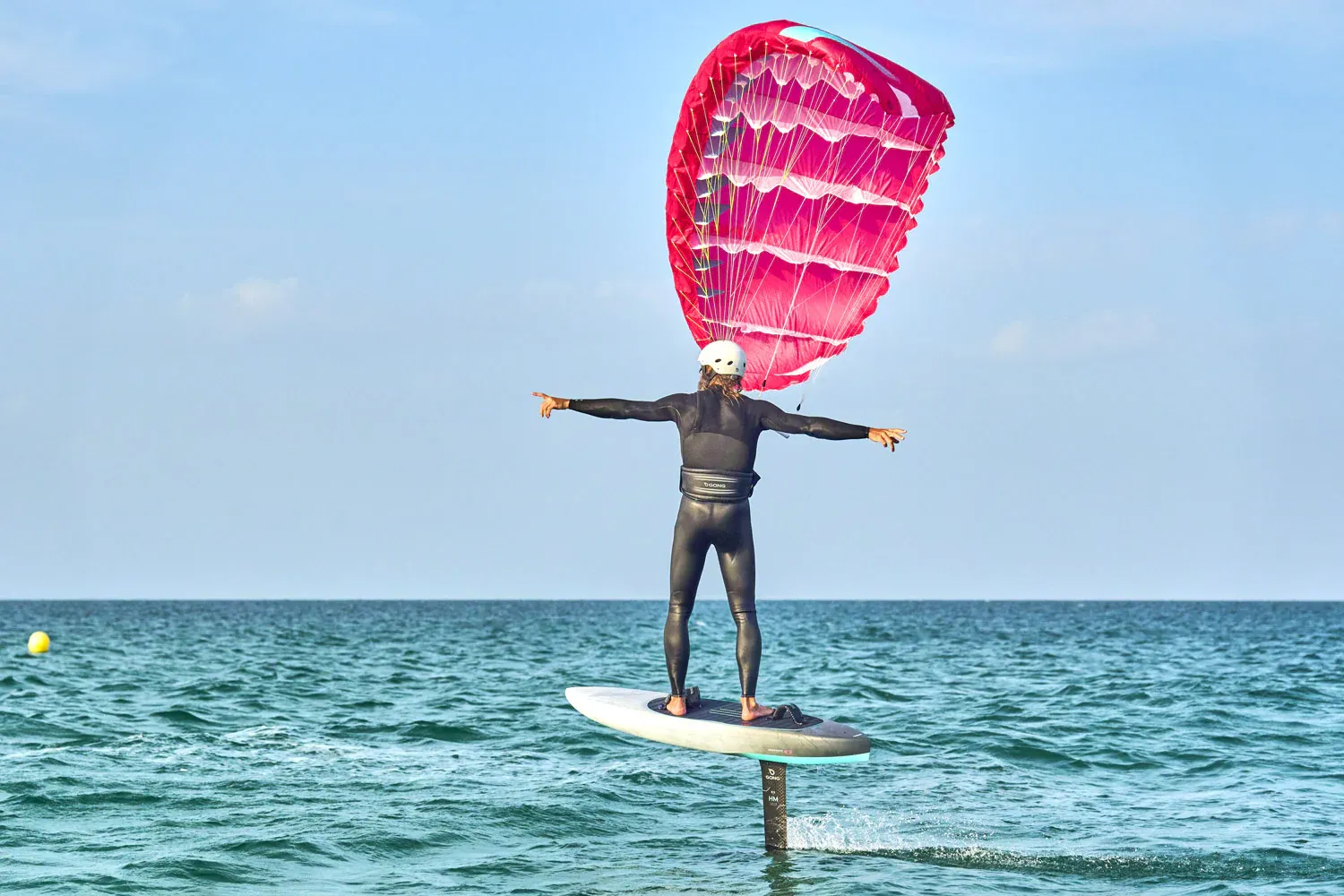
The POW is a single-skin parawing designed for harness-based foiling. It launched with three sizes (1.7m, 2.5m, and 4.0m) and has since added a 5.0m for light wind conditions.
Available sizes: 1.7m, 2.5m, 4.0m, 5.0m
Construction: Nylon sailcloth canopy with flexible nylon battens on the leading edge, anti-flutter ribs, and minimal ribbing for weight reduction
Bar: 42cm ergonomic carbon J-shaped pistol grip with pin-access bridle attachment and EVA grip
Unique features: Four-bridle system with pulley mechanism on the fourth set for automatic profile adjustment across the power range, coated bridle lines (visible underwater, snag-resistant)
What’s included: POW wing, POW Bag [M], 42cm Parawing Handle, safety guide, repair kit
Specs by Size
| Size | Weight | Aspect Ratio | Approximate Wind Range (knots) |
|---|---|---|---|
| 1.7m | 600g | 2.8 | 28+ |
| 2.5m | 680g | 2.8 | 20 to 30+ |
| 4.0m | 820g | 2.8 | 14 to 24 |
| 5.0m | TBC | 2.8 | 10 to 18 |
Wind ranges are approximate. MACkite tested the 2.5m with a 90kg rider and found it usable from 22 to 30+ knots. Lighter riders will get more range from smaller sizes.
The Four-Bridle System
The POW’s standout engineering feature is its four-bridle system. Most parawings use two or three bridle sets. The POW adds a fourth set with a pulley mechanism that automatically adjusts the canopy profile as wind pressure changes. In practice, this means the wing maintains a more consistent shape across its power range, reducing the rider’s need to actively manage trim.
The trade-off is complexity. All four bridle sets use coated lines in the same colour, which makes identifying and untangling individual lines slower than on wings with colour-coded bridles (like the F-One Frigate or Ozone Pocket Rocket). It’s a design choice that prioritises performance over convenience.
The line length on the 4.0m is 210cm, the longest of any competitor in that size range. That places the wing higher in the wind window, which contributes to the POW’s strong low-end power and upwind angles but also means larger sizes don’t pack quite as small as shorter-lined competitors.
Pros and Cons
Pros:
- Widest usable wind range of any parawing tested
- Exceptional low-end power, keeps you riding in marginal conditions
- Best-in-class upwind angles (“bonkers fast upwind” per The Inertia)
- Four-bridle pulley system provides smooth, automatic profile adjustment
- 20+ years of foil kite heritage directly informs the aerodynamic design
- Coated bridle lines are visible underwater and resist snagging
- POW Academy: free 6-episode video tutorial series for new riders
- Robust build quality with nylon sailcloth and flexible battens
Cons:
- Same-colour bridle lines slow down tangle identification and setup
- 42cm bar is larger than most competitors (29cm to 41cm is typical for mid-range sizes)
- Heavier than the lightest competitors (BRM, Ozone) at equivalent sizes
- Only four sizes compared to eight from F-One or six from Ozone
- Longer lines on the 4.0m reduce packability slightly
- 5.0m weight and pricing not yet confirmed by all retailers
Community Feedback
The POW has generated strong opinions in the parawingfoiling community, and the consensus is clear: this is a specialist wing for riders who value wind range and low-end grunt above all else.
The most consistent praise centres on the usable wind range. Riders report staying on the water in conditions where other parawings have lost power, and the transition from low-end cruising to overpowered blasting feels smoother than on most competitors. MACkite’s testing of the 2.5m at 90kg confirmed usable performance from 22 knots through 30+, which is a wide band for a single wing.
Upwind performance draws repeated praise. The Inertia described it as “bonkers fast upwind,” and community feedback supports this. The four-bridle pulley system and longer line lengths position the wing higher in the wind window, which translates directly into pointing ability. Riders coming from foil kites find the upwind angles immediately familiar.
The low-end power is the other headline feature. Several riders describe the POW as having noticeably stronger pull in marginal conditions compared to the Ozone Pocket Rocket and F-One Frigate at equivalent sizes. For riders in locations with inconsistent wind, this is a meaningful advantage.
On the critical side, the same-colour bridle lines are the most frequently mentioned frustration. When lines tangle (and they will), identifying which bridle set each line belongs to takes longer than on colour-coded systems. Experienced riders learn to manage this quickly, but it’s an unnecessary friction point for newer riders.
The 42cm bar size also divides opinion. Some riders find the larger grip comfortable and appreciate the control authority. Others, particularly those with smaller hands or those used to compact BRM and Ozone bars, find it oversized for the smaller wing sizes.
How Does the POW Compare to the F-One Frigate?
These two wings represent different philosophies. The Frigate is the best all-rounder. The POW is the wind range and low-end specialist.
Choose the POW if: You regularly ride in marginal or variable wind conditions and want the widest usable range from a single wing. You value upwind performance above all else. You have foil kite experience and appreciate the familiar handling characteristics.
Choose the Frigate if: You want the most balanced all-round performance from a single model. You value colour-coded bridle lines and a smaller bar for compact sizes. You want the widest size selection (8 sizes vs 4). You prefer a wing from a brand with broader water sports credentials and easier setup.
How Does the POW Compare to the Ozone Pocket Rocket?
Both the POW and Pocket Rocket are premium parawings from brands with deep foil heritage. They share strong upwind performance but differ in character.
Choose the POW if: You want the strongest low-end power and the widest wind range. You ride in conditions where squeezing every knot out of light wind matters. You’re comfortable with the longer lines and single-colour bridle system.
Choose the Pocket Rocket if: You want a lighter, more compact wing with a shorter 40cm carbon bar. You value colour-coded bridles for faster setup. You prefer Ozone’s decades of paraglider heritage and their two-model approach (Pocket Rocket for all-round, PowerPack for stash-and-glide). You ride in gusty or messy conditions where the Pocket Rocket’s settled, composed handling excels.
How Does the POW Compare to BRM?
BRM and Flysurfer are the two brands with the deepest heritage in the parawing space (BRM from boardsports, Flysurfer from foil kites). They approach design very differently.
Choose the POW if: You want the widest wind range and strongest low-end power from a single model. You value the automatic profile adjustment of the four-bridle pulley system. You prefer a wing backed by foil kite aerodynamic expertise.
Choose BRM if: You want the lightest, most packable parawings on the market. You prefer specialised models for different riding styles (Kanaha for all-round, Ka’a for surf, Maliko 2 for downwind, Paia for comfort). You want the heritage of the brand that created parawingfoiling.
POW Sizing Guide
| Rider Weight | Light Wind (10–18 kts) | Moderate (16–24 kts) | Strong Wind (22–30+ kts) |
|---|---|---|---|
| Under 65kg | 4.0m | 2.5m | 1.7m |
| 65–80kg | 5.0m | 4.0m | 2.5m |
| 80–95kg | 5.0m | 4.0m | 2.5m |
| Over 95kg | 5.0m | 4.0m–5.0m | 2.5m–4.0m |
These are guidelines based on available community data and MACkite testing. Your board, foil, and skill level all affect the ideal size. See our parawing size guide for a full comparison across all brands.
The four-size range is more limited than some competitors. F-One offers eight sizes and Ozone offers six. If you need precise size matching for a narrow wind window, the POW’s gaps between sizes (1.7m to 2.5m to 4.0m to 5.0m) are wider than the competition. The flip side is that each POW size covers a broader usable range, so fewer sizes may be all you need.
Where to Buy the Flysurfer POW
Pricing
| Size | GBP | EUR | USD |
|---|---|---|---|
| 1.7m | ~£675 | €699 | $599–$734 |
| 2.5m | ~£620 | €639 | $699–$839 |
| 4.0m | ~£700 | ~€750 | $799–$944 |
| 5.0m | TBC | €999 | ~$1,049 |
Pricing varies between retailers. USD ranges reflect different dealer pricing in the US market.
UK dealers:
- Kite Wing and Foil (kitewingandfoil.co.uk)
- Powerkiteshop (powerkiteshop.com)
- The SUP Company (thesupco.co.uk)
- Kitesurf.co.uk
US dealers:
- MACkite Boardsports (mackiteboarding.com)
- Gorge Performance (gorgeperformance.com)
- REAL Watersports (realwatersports.com)
- Adventure Kiteboarding (adventurekiteboarding.com)
- Big Winds (bigwinds.com)
EU dealers:
- Surfpirates (surfpirates.de, Germany)
- Boardsports.eu
- Varuste.net (Finland)
Australian dealers:
- Kite Republic (kiterepublic.com.au)
- Action Sports WA (actionsportswa.com.au)
- BrisKites (briskites.com.au)
Frequently Asked Questions
Is the Flysurfer POW good for beginners?
The POW is a capable wing, but the same-colour bridles and longer line lengths add complexity that newer riders may find frustrating. If you’re new to parawingfoiling, a more straightforward option like the Gong Lowkite or Aeryn P1 provides a gentler learning curve. If you have foil kite or paragliding experience, the POW’s handling will feel immediately intuitive.
What makes the four-bridle system different?
Most parawings use two or three bridle sets to control the canopy shape. The POW’s fourth set includes a pulley mechanism that automatically adjusts the wing’s profile as wind pressure changes. This provides smoother power delivery across a wider wind range without the rider needing to actively manage trim. The trade-off is that four sets of same-colour lines are harder to untangle than two or three sets of colour-coded lines.
What size POW should I get?
For a 70–85kg rider in moderate conditions (16–24 knots), the 4.0m is the most versatile choice. The 2.5m covers strong wind days, and the 5.0m extends into genuine light wind territory. See our parawing size guide for detailed recommendations across all brands and rider weights.
Is the POW Academy worth watching?
Yes. It’s a free 6-episode video series that covers setup, launching, riding, and progression. It’s the most comprehensive structured tutorial from any parawing brand, and it’s useful even if you don’t own a POW. Flysurfer is the only brand offering this level of educational content.
How does the POW pack down?
The POW packs to roughly hoodie size. No pump or bladders are needed. The included POW Bag [M] is a drawstring sling bag. The 4.0m’s longer 210cm lines mean it doesn’t pack quite as compact as shorter-lined competitors like BRM, but it’s still significantly smaller than any inflatable wing.
The Verdict
The Flysurfer POW is the wind range specialist. If you ride in variable or marginal conditions and want a single wing that stays powered when others have given up, the POW delivers. The four-bridle pulley system provides genuinely smooth power delivery across a wider band than any competitor, and the upwind performance is among the best in the category.
The honest caveats: same-colour bridles are a frustration, the four-size range is narrower than F-One’s eight or Ozone’s six, and the 42cm bar is larger than some riders prefer. If you want the best all-rounder, the F-One Frigate edges ahead. If you want the lightest, most packable option, BRM wins.
But for riders who prioritise wind range, low-end power, and upwind angles, the POW is the strongest option on the market. Flysurfer’s 20+ years of foil kite expertise shows in every aspect of the design.
Head-to-Head Comparisons
- Flysurfer POW vs F-One Frigate: wind range specialist vs all-rounder
More on Flysurfer
Our brand overview covers Flysurfer's history, full product range, and where to buy.
Read the Flysurfer brand overview