Aeryn Review
Aeryn P1 Pocket Wing Review: Full Guide for 2026

The Aeryn P1 Pocket Wing is the most affordable parawing on the market. That’s the headline, and it’s a significant one. Parawingfoiling already costs less than kiteboarding or wingfoiling, but the equipment still represents a real investment. The P1 lowers the entry barrier further than any other wing available.
What makes it more interesting than a simple budget option is the team behind it. Aeryn is backed by Equipe Trading B.V., the Netherlands-based parent company behind Peter Lynn Kiteboarding (PLKB), Exocet, Loftsails, and Unifiber. The engineers designing the P1 have 20+ years of experience building ram-air soft wings. This isn’t a startup guessing at canopy design. It’s an established engineering team applying proven expertise to a new form factor.
This guide covers the full P1 specs, honest assessment of where it excels and where it falls short, community feedback, and how it compares to other parawings at different price points.
About Aeryn
Aeryn launched in 2025 as a new brand focused on parawingfoiling. The name is new, but the pedigree is not. Equipe Trading B.V., founded in 2002 in the Netherlands, runs a portfolio of water sports brands with distribution across 60+ countries and 650+ retailers globally.
The most relevant heritage is Peter Lynn Kiteboarding (PLKB). Peter Lynn is one of the pioneers of traction kiting, and PLKB has been producing ram-air kites for decades. The P1’s construction details (spliced Dyneema bridles, trailing edge micro rod, flexible battens) reflect engineering decisions that come from long experience with soft wing aerodynamics, not from copying competitors.
Aeryn’s positioning is deliberate: minimal, durable, and intuitive. They’ve chosen to launch with a single model in four sizes rather than fragmenting across multiple products. The focus is on getting the core product right.
The Aeryn P1 Pocket Wing
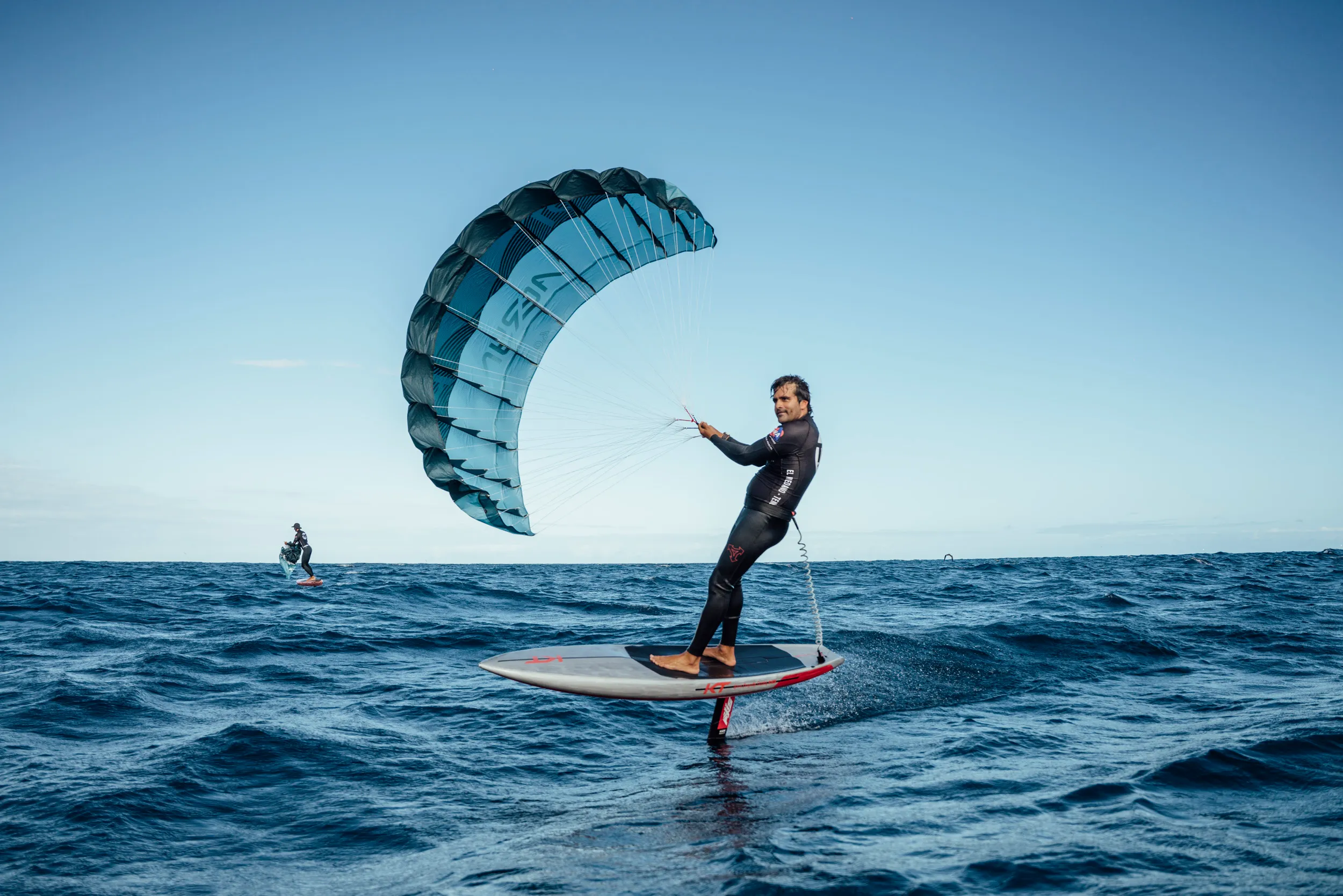
The P1 is a single-skin parawing designed for harness-based foiling. It’s available in four sizes with two colour options.
Available sizes: 3.0m, 4.0m, 5.0m, 6.0m
Colours: Ocean Blue, Coral Red
Construction: Single-skin ripstop canopy with leading edge and trailing edge battens, spliced Dyneema bridle (knot-free, high tensile strength), compact EVA foam bar
Unique features: Trailing edge micro rod for shape retention during depower, colour-coded pigtails for quick line identification, low bridle count for simplified setup
What’s included: P1 wing, bar and lines, drawstring sling bag
Estimated Wind Ranges by Size
| Size | Approximate Wind Range (knots) | Best For |
|---|---|---|
| 3.0m | 20–35 | Strong wind, lighter riders |
| 4.0m | 15–28 | Moderate to strong, most versatile |
| 5.0m | 12–22 | Moderate conditions, all-round |
| 6.0m | 10–18 | Light wind, heavier riders |
Aeryn does not currently publish detailed official wind ranges. These are estimates based on comparable single-skin designs and community reports. Actual performance varies by rider weight, skill level, board, and foil setup.
Construction Details
The P1 uses a spliced Dyneema bridle rather than the knotted or swaged connections found on some competitors. Splicing eliminates knots entirely, which reduces weight, improves durability (knots are stress concentration points), and maintains the line’s full tensile strength. It’s a detail that signals engineering seriousness from a brand selling at budget prices.
The trailing edge micro rod is a precision-placed stiffening element near the trailing edge that minimises canopy distortion during depower. When you sheet out, the trailing edge retains its shape rather than fluttering or collapsing inward. Not every parawing has this, and its presence on the P1 is one of the clearest signs of the Peter Lynn heritage.
The low bridle count keeps setup simple. Fewer lines mean fewer tangles and faster rigging. Combined with colour-coded pigtails, the P1 is one of the quickest parawings to get from bag to air.
Pros and Cons
Pros:
- Most affordable parawing on the market, significantly undercutting every competitor
- Backed by 20+ years of ram-air kite design expertise (Peter Lynn/PLKB heritage)
- Spliced Dyneema bridle is strong, light, and durable
- Trailing edge micro rod maintains wing shape during depower
- Low bridle count and colour-coded pigtails make setup fast and intuitive
- Four sizes covering 10 to 35 knots (estimated)
- Available through a growing global dealer network
- Strong low-end power generation for its price point
Cons:
- Upwind performance is behind the premium brands (Ozone, BRM, F-One, Flysurfer)
- Beach handling requires some familiarisation to find the correct flying angle
- Brand new to the market with limited long-term rider feedback (launched 2025)
- Only four sizes, with no option below 3.0m for high-wind specialists
- Specific pricing is harder to confirm (varies significantly by retailer and region)
Community Feedback
The P1 is still relatively new, and the volume of independent rider feedback is smaller than for established brands like Ozone or BRM. That said, the early feedback follows a consistent pattern.
The most common praise centres on value. Riders describe the P1 as performing well above its price point, with several noting they expected compromises that didn’t materialise. The build quality, particularly the spliced Dyneema bridle and trailing edge micro rod, draws positive comments from riders who understand the engineering behind those choices.
Low-end power is another consistent positive. For a budget wing, the P1 generates surprisingly strong pull in lighter conditions. Riders coming from inflatable wings or hand-held wings notice the difference immediately.
The main criticism is upwind performance. The P1 doesn’t point as high as the Ozone Pocket Rocket, F-One Frigate, or Flysurfer POW. For riders in locations where upwind ability matters (tidal spots, narrow channels), this is a real limitation. For riders at open-water spots with plenty of room downwind, it’s less of a concern.
Beach handling also comes up. Finding the right angle to keep the P1 flying steadily while standing on the beach takes a few sessions to learn. Once you’re on the water and hooked in, the handling becomes more intuitive, but the first few launches can feel less polished than on premium wings that have had more development cycles.
MACkite has reviewed the P1 and confirmed it as a legitimate entry point to the sport, not just a cheap compromise. That’s meaningful given their experience testing every major parawing on the market.
How Does the P1 Compare to the Gong Lowkite?
This is the most direct comparison. Both wings target value-conscious buyers, and both have earned respect as legitimate parawings rather than budget compromises.
Choose the P1 if: Price is the primary factor, and you want the absolute lowest entry cost to parawingfoiling. You value the engineering pedigree (Peter Lynn heritage, spliced Dyneema, trailing edge micro rod). You prefer colour-coded pigtails for faster setup.
Choose the Gong Lowkite if: You want a wider size range (Gong offers 3m to 7m, covering more wind conditions). You value Gong’s more established community presence and longer track record in parawingfoiling. You want direct purchasing from Europe with straightforward pricing.
Both are excellent starting points. The P1 is cheaper. The Lowkite offers more size options. Neither will disappoint.

How Does the P1 Compare to Premium Parawings?
The honest answer: the P1 is not going to match an Ozone Pocket Rocket, F-One Frigate, or Flysurfer POW on pure performance. Those wings cost two to three times more, have had more development iterations, and use higher-grade materials.
Where the gap is largest is upwind performance and high-wind stability. Premium wings point higher, handle gusts more composedly, and offer more refined bridle systems.
Where the gap is smallest is in the core riding experience. Once you’re foiling on a P1, you’re parawingfoiling. The fundamental sensation of harness-based foiling, the silence, the efficiency, the glide: it’s all there. For riders whose priority is getting into the sport rather than optimising every aspect of performance, the P1 delivers the experience at a fraction of the cost.
For many riders, the smartest approach is to start on a P1, learn the fundamentals, and then upgrade to a premium wing once you know what riding style and conditions suit you best. A P1 also makes an excellent second wing for strong wind days once you’ve added a larger premium wing for lighter conditions.
P1 Sizing Guide
| Rider Weight | Light Wind (10–18 kts) | Moderate (15–25 kts) | Strong Wind (22–35 kts) |
|---|---|---|---|
| Under 65kg | 5.0m | 4.0m | 3.0m |
| 65–80kg | 6.0m | 5.0m | 3.0m–4.0m |
| 80–95kg | 6.0m | 5.0m–6.0m | 4.0m |
| Over 95kg | 6.0m | 6.0m | 4.0m–5.0m |
These are guidelines based on estimated wind ranges and comparable parawings. See our parawing size guide for detailed recommendations across all brands and rider weights.
The 5.0m is the most versatile size for most riders in moderate conditions. If you’re buying your first parawing and ride in typical 14 to 22 knot conditions, that’s the one to start with.
Where to Buy the Aeryn P1
The P1 is available through a growing network of dealers and directly from Aeryn. Pricing is the lowest of any parawing on the market, though exact figures vary by retailer and region. Expect to pay under £600 / €700 / $900 for most sizes.
Direct:
- Aeryn (aeryn.world), ships internationally
UK dealers:
- Powerkiteshop (powerkiteshop.com)
- SUP.co.uk
US dealers:
- MACkite Boardsports (mackiteboarding.com)
EU dealers:
- Wake Style (wake-style.de)
- EASY-surfshop (easy-surfshop.com)
- inLand (Belgium)
For a full list of global stockists, see the Aeryn dealer locator.
Frequently Asked Questions
Is the Aeryn P1 good for beginners?
The P1 is one of the best options for beginners, primarily because of its low price. The low bridle count and colour-coded pigtails also simplify setup. The main learning curve is beach handling, which takes a few sessions to master. Once you’re on the water, the P1 is forgiving and intuitive. If you’re completely new to parawingfoiling, start with our guide to getting started.
How does the P1 compare to more expensive parawings?
The P1 performs well for its price but doesn’t match premium wings on upwind performance, high-wind stability, or refinement. The core parawingfoiling experience is the same. Most riders won’t notice the performance gap until they’ve developed enough skill to push the wing’s limits. See our best parawings guide for a full comparison across all brands and price points.
What size Aeryn P1 should I get?
For most riders (65 to 85kg) in moderate conditions (14 to 22 knots), the 5.0m is the most versatile starting point. If you’re lighter or ride in stronger wind, the 4.0m covers a broad range. The 6.0m extends into genuine light wind territory. See our parawing size guide for detailed recommendations.
Who is behind Aeryn?
Aeryn is a brand under Equipe Trading B.V., a Netherlands-based company founded in 2002. Their portfolio includes Peter Lynn Kiteboarding (PLKB), Exocet, Loftsails, and Unifiber. The team designing the P1 has 20+ years of ram-air kite engineering experience, primarily from the Peter Lynn heritage. Read our full Aeryn brand overview for the complete story.
Can I use the P1 as a second wing?
Absolutely. Many riders who own a premium 4.0m or 5.0m wing for moderate conditions add a P1 in a smaller size (3.0m or 4.0m) for strong wind days. At this price point, it’s a cost-effective way to extend your quiver without spending premium prices on a wing you’ll use less frequently.
The Verdict
The Aeryn P1 Pocket Wing is the most accessible way into parawingfoiling. It costs less than every competitor, and the Peter Lynn heritage means the engineering behind it is more serious than the price suggests. The spliced Dyneema bridle, trailing edge micro rod, and thoughtful construction details set it apart from what you’d typically expect at this price point.
It’s not a premium performer. Upwind ability and high-wind composure lag behind the Ozone Pocket Rocket, F-One Frigate, and Flysurfer POW. Beach handling takes some learning. Long-term durability data is limited given how new the brand is.
But for riders whose priority is getting on the water at the lowest cost, or for experienced riders adding a strong-wind wing to their quiver without spending premium prices, the P1 is a genuine option. It’s not just cheap. It’s a well-engineered wing that happens to cost less than everything else.
Head-to-Head Comparisons
- Aeryn P1 vs Gong Lowkite: the two most affordable parawings compared
More on Aeryn
Our brand overview covers Aeryn's history, full product range, and where to buy.
Read the Aeryn brand overview