Ozone Review
Ozone Pocket Rocket V2 Parawing Review (2026)

Ozone listed the Pocket Rocket V2 on 1 May 2026. It supersedes the wing we have long treated as the default Ozone parawing, and it arrives with the shortened bridle layout Ozone developed for the PowerPack, a new bar, a split A-line, and a seventh size.
We have not ridden the V2. What this page does instead is set the specifications we could verify against what the riders who have spent time on it report. We have leant on two in particular, chosen because neither sells the wing and because one of them owns a V2 and a PowerPack in the same size and rides a four-wing quiver split between the two models, which makes him the most useful source on this wing we have found. Everything below is either a specification we read from a named source, a claim Ozone make about their own product, or an impression attributed to the rider who formed it.
The Two Riders We Have Leant On
There is more V2 coverage than this, and more arriving. These are the two we have built the page on, and it is worth saying why.
Ash of Wing-Tips, “Pocket Rocket V2 vs Power Pack, Which Should You REALLY Buy?”. This is the same rider whose long-term ownership review anchors our PowerPack page: he buys his own wings from his local shop, has no commercial relationship with Ozone, and rides equipment for a long stretch before filming rather than forming a verdict in an afternoon. For this comparison he owns both wings and puts a 4.3m against a 4.3m, which removes the size variable that makes most cross-model comparisons soft. He is our primary source.
Hydro Gav, “Ozone Pocket Rocket V2, Where’s the Catch?”. More positive overall, and it is his personal choice: “At the time of filming this, I don’t think anybody’s done it better.” He is also the source for several product details Ozone do not put in a spec table, and for the sharpest criticisms on this page.
Both are independent of Ozone and of any shop selling the wing, which is why they are here rather than the dealer reviews. They disagree in places, and where they do we have kept both rather than picking one.
Specs by Size
Seven sizes, up from six on the V1. The new 5.7m extends the range at the light end.
| Size | Weight (bar included) | Bar | Cells |
|---|---|---|---|
| 1.9m | 440g | 33cm | 14 |
| 2.4m | 480g | 33cm | 14 |
| 3.0m | 570g | 33cm | 18 |
| 3.6m | 630g | 36cm | 18 |
| 4.3m | 690g | 36cm | 18 |
| 5.0m | 745g | 36cm | 18 |
| 5.7m | 795g | 36cm | 18 |
Ozone’s published figures from ozonekites.com, checked 4 August 2026. Weights are stated as including the control bar.
Ozone do not publish aspect ratio, line lengths, canopy material or packed dimensions for the V2. They do publish a per-size wind range chart, which is covered further down. What follows on features comes from the riders rather than from a spec sheet.
The Split A-Line
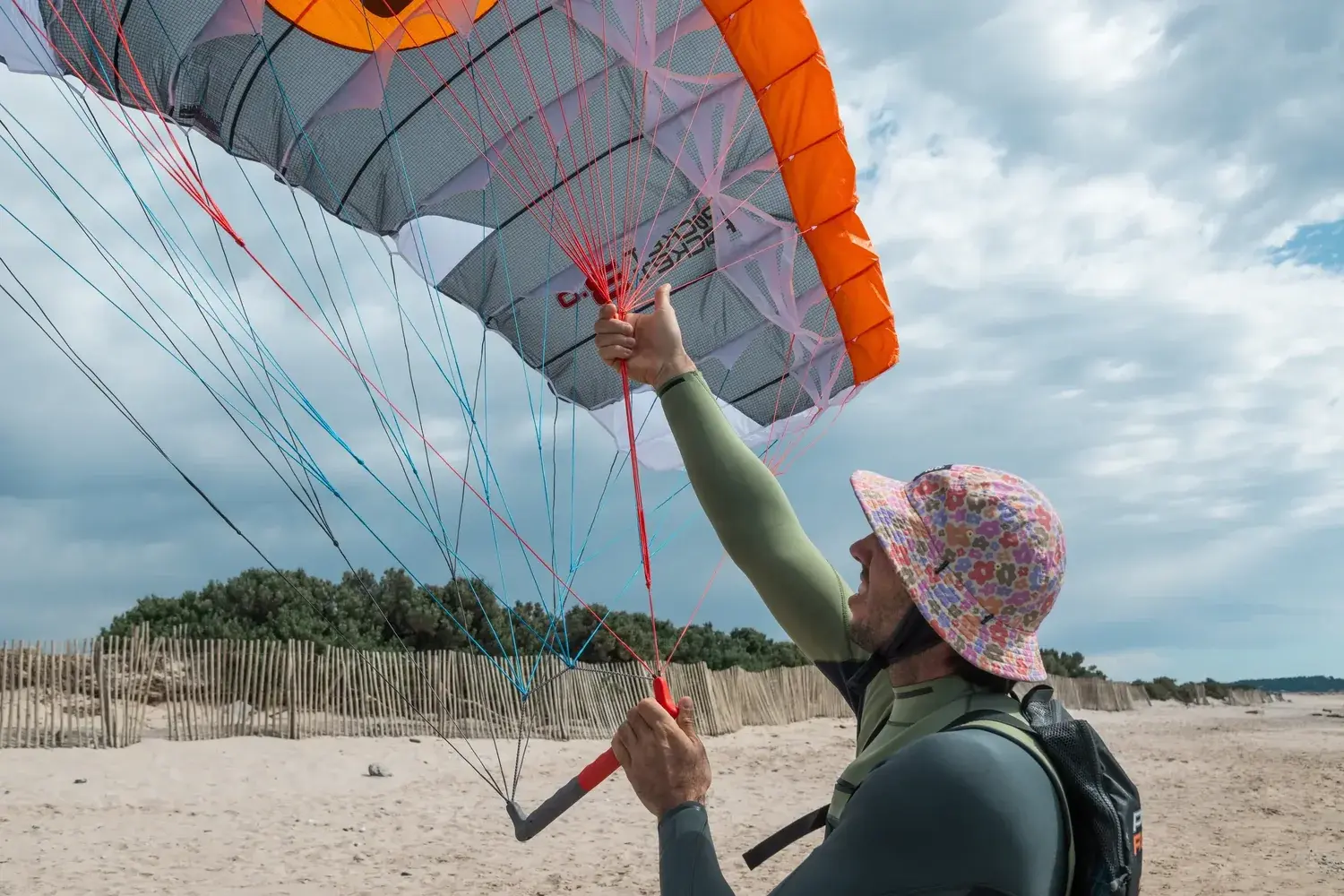
The V2 has a split in the A-line, as the PowerPack does, so you can collapse the wing while it is still powered up. Gav is emphatic about it: “This is not a gimmick. You can just dump the wing instantaneously. Whether that’s on the beach, mid-run, even powered up on a wave, it just disappears.”
The cost is that you then have to tidy up the tips, or ears, afterwards, which he describes as slightly awkward but worth it. You can avoid that by doing a full pack instead, grabbing all the A lines together, which removes the ears problem at the price of the instant dump.
Lines, Bar and Yoke
Lines. Shortened from the V1. Gav: “Fully spliced lines, no knots, no joints, nothing catching when you’re running your hands down. It’s as close to zero friction as you can get.” He rates them as the class leader, “I’d say Ozone have the best lines out there at the moment, by some margin”, and on the largest size, where line length usually starts to hurt, “The 5m is usually where you notice problems, but it’s the Goldilocks length.” He reports no trouble packing the big sizes with an average arm span.
Bar. Taken from the PowerPack. He rates the length as spot on, says the 5m is easy to stash while keeping full control through the range, and notes the lines feed away from the bar cleanly.
Yoke system. Smooths power delivery and allows more profile change, which he credits with adding range and removing the slightly on-off feel of setups that run direct to the bar.
Bag. The Velcro he complained about on the V1 is now a clip, so mid-session wing swaps are seamless, and the strap stitching is flush so lines do not catch. A mini mission pack is included as standard, which he rates as the best included solution on the market.
What Actually Changed From the V1
This is the comparison most people arriving here want, and it is worth being careful about because the two generations are easy to compare wrongly.
Ozone quote the V2 weights as including the bar. The V1 figures we have carried since launch are on the same basis: Ozone’s own 2025 Pocket Rocket spec sheet gives them under the heading “Weight, bar incl (kg)”, and its bar length and cell counts match our published table exactly. So the two sets are like for like, and the difference below is real rather than an artefact of two different measuring conventions.
| Size | V1 (bar incl) | V2 (bar incl) | Change |
|---|---|---|---|
| 1.9m | 400g | 440g | +40g |
| 2.4m | 450g | 480g | +30g |
| 3.0m | 540g | 570g | +30g |
| 3.6m | 590g | 630g | +40g |
| 4.3m | 640g | 690g | +50g |
| 5.0m | 700g | 745g | +45g |
| 5.7m | not made | 795g | new size |
V1 figures from Ozone’s 2025 Pocket Rocket specification sheet, published by MACkite Boardsports (mackiteboarding.com), read 4 August 2026. V2 figures from ozonekites.com, checked 4 August 2026.
The V2 is heavier at every size it shares with the V1, by 30g to 50g, or roughly 6 to 10 per cent. Two other spec changes are worth putting next to that. The bar is shorter: 40cm across the whole V1 range, against 33cm on the three smallest V2 sizes and 36cm on the four largest. And the V2 has one fewer cell at every matched size, 14 against 15 on the two smallest and 18 against 19 on the rest.
So the wing gained weight while losing a cell and shortening its bar, which is the opposite of what you would expect if Ozone were chasing a lower number. Ozone do not break out how much of the total is bar, so we cannot tell you precisely where the weight went, but the direction is consistent with what they say they did to the canopy: a refined profile, improved canopy tension, and a diagonal rib support structure. Added structure costs grams.
Line length also changed, and it cuts both ways. Gav reports the V2’s lines as shorter than the V1’s. Ash reports them as still longer than the PowerPack’s. Both can be true, and together they place the V2 between the two: shorter than the wing it replaces, longer than the wing it borrows its bridle from.
What Ozone Say Is New
All of the following is Ozone’s own description of their product.
- A shorter bridle set-up, which Ozone explicitly describe as inspired by the PowerPack
- A new Bow Bar design, in the shorter lengths above
- A new compact shape, which they say reduces the chance of contact with the water
- A refined profile and improved canopy tension, including a diagonal rib support structure
- A new front line material with a coating for smoother handling and faster packing
- A reduced aspect ratio, which they credit for easier inflation, more nimbleness and more control
The Aspect Ratio Contradiction
That last claim is disputed, and we would rather show you the disagreement than quietly pick a side.
Ozone’s marketing says the V2 has a reduced aspect ratio. Gav, riding it, describes it as “slightly higher aspect”. Those cannot both be right as stated. Ozone publish no aspect ratio figure for either generation, so there is no number anyone can check it against, and the one spec that bears on it points Ozone’s way: the V2 has one fewer cell per size, which is at least consistent with a lower aspect planform.
So: the manufacturer claims lower, one independent reviewer who has flown it perceives higher, and there is no published figure to settle it. If aspect ratio is the deciding factor in your purchase, that is the honest state of the evidence.
V2 vs PowerPack, Category by Category
This is Ash’s comparison, 4.3m against 4.3m, from owning both. We have not editorialised the calls.
| Winner | Why | |
|---|---|---|
| Low end | Draw | Accessed differently. The PowerPack pulls harder but needs a more downwind angle to gather momentum. The V2 responds far better to being pumped. |
| Top end | V2, clearly | Flies further forward in the window, so more range, more effective depower and more stability in gusts. |
| Speed | V2, clearly | |
| Upwind | V2, significantly | And it needs far less power in the wing to hold a good angle. |
| Steering | PowerPack | The V2 has longer lines and much looser rear lines when depowered, so it is less reactive. |
| Stowing | PowerPack, clearly | Less material, fewer battens, fewer lines, packs much smaller, much less tangle risk. |
| Redeploy | PowerPack | Shorter lines and less material make it simpler, faster and more reliable. |
| Back stall | V2 | Both now share the same bar size, but the V2 is less sensitive, giving more usable bar travel before it stalls. |
| Grabbing the lines | Draw | Both have separated A lines and the same comfortable line material. |
On the low end, the interesting detail is how the V2 gets there. Ash likens pumping it to pumping an inflatable wing: you generate power from the wing rather than doing all the work with your legs. The PowerPack instead wants a more downwind angle to build momentum. Same outcome, different technique, which matters if you are used to one and switching to the other.
On upwind, one finding is worth pulling out because nobody else reports it. In Ash’s words: “You can actually just taxi along very slowly and still go upwind, whereas the power pack will definitely not allow you to do that.” If you have ever dropped off foil a long way downwind of your launch, you will know why that is worth more than a couple of degrees of angle.
On the top end, Ash is blunt about the PowerPack’s ceiling. It is physical to fly overpowered, you know when you have hit its limit, and he has been stuck between sizes on it: “The 4.3 is a very grunty wing and has always been my least favourite of the power packs.” The V2 flying further forward in the window is what buys back that range.
On steering, which is the V2’s one real weakness in either review. The V2’s longer lines and much looser rear lines when depowered make it less reactive than the PowerPack, and Ash notes this is most pronounced when you are using a lot of depower. It is not unfixable: you can counter it with manual rear-line input. But it is the clearest thing either reviewer marks the V2 down for, and it is in our cons list below rather than buried here.
On stowing, Ash is unambiguous: “Big win on stowing for the power pack. It’s just a lot nicer, easier and faster to stow with. Less chance of a tangle in that process.”
Reconciling the Two on Collapsing
At first glance the reviewers contradict each other. Ash says the V2 takes more force to collapse when powered. Gav says it dumps instantaneously.
Both are right, because they are measuring against different things. Ash is comparing the V2 with a PowerPack, which is the easiest wing in the category to pull out of the sky. Gav is comparing it with parawings that have no split A-line at all, against which an instant dump is remarkable. If you are coming from a PowerPack the V2 will feel like more work. If you are coming from almost anything else, including the V1, it will feel like a step forward.
Ash’s Five Use Cases
This is the most useful thing published about the V2 anywhere, and it is our own usage-profile-beats-spec-sheet argument applied by the rider we built the PowerPack page on. He does not pick a winner overall. He picks per scenario.
- Riding 30 minutes upwind then downwind back: Pocket Rocket
- Lapping a swell spot, 1 to 2km out and surfing back, beach break: PowerPack, because reliability of stow and redeploy dominates
- General freeride, mostly riding on the power: Pocket Rocket
- Small, windblown or unreliable swell with very short rides: PowerPack, unless it is light wind, in which case the V2’s upwind wins
- Light wind: Pocket Rocket, because the PowerPack needs power to make upwind angles and can struggle to make progress
Note what case 4 does. It takes the profile we have been describing as PowerPack territory and splits it on wind strength, which is a finer distinction than we were drawing.
His Own Quiver
The single most useful paragraph in his review is what he actually owns after all this: a 4.3m Pocket Rocket V2 purely for getting upwind in light wind, and PowerPacks at 3.6, 3.0 and 2.4.
His reasoning is that his spot gives rideable swell at 3.6 and below, and in those sizes stow and redeploy is the main driver while upwind matters much less. The condition he sets for changing his mind is precise: “I run the power pack until something comes along that stows and redeploys just as well, but maybe improves a bit of upwind and overpowered handling.”
That is a more precise conclusion than saying it depends on your spot. It depends on your size and your wind: the biggest wing in the quiver, used in the lightest wind, is the one where the V2’s upwind advantage pays, and the smaller wings are where stash reliability wins.
Wind Range
Ozone publish a per-size wind range chart for the V2, covering all seven sizes across an axis running from 10 to 45 knots.
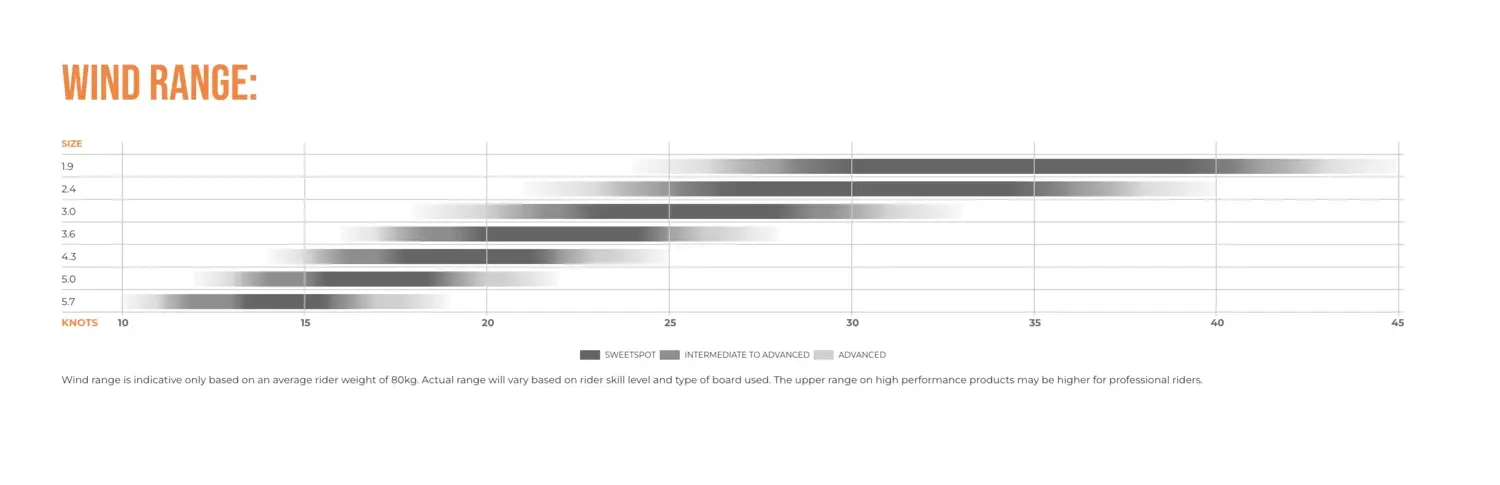
What the chart is actually good for is direction rather than precision. The bands are gradients with no printed figures at their ends, so we are not going to convert them into knot values, and you should be wary of anyone who does. Read it instead for three things. The largest sizes sit low in the range and the smallest sit high, shifting steadily across the chart as the sizes step down. The sizes overlap heavily, so neighbouring sizes cover much of the same wind and the choice between two adjacent sizes is rarely critical. And each size is split into three shaded bands, a sweetspot with intermediate-to-advanced and advanced bands either side, so the usable range is wider than the comfortable one and how much of it you can reach depends on your own level.
Ozone’s own caveat sits under the chart: the figures are indicative only, based on an average rider weight of 80kg, with actual range varying by rider skill and the type of board used, and the upper range on high-performance wings potentially higher for professional riders. For sizing across brands, see our parawing size guide.
What the riders add. Gav was surprised by the low end, and credits the C-line connection tabs, which he likens to lowering flaps on an aircraft. He still thinks the PowerPack has the better low end, but not by far, which sits alongside Ash calling the low end a draw accessed differently. On the top end he reports the canopy holding shape with no collapsing, but he is explicit that he has not had it out in nuking winds yet, so that is an untested ceiling rather than a verified one.
What It Costs
We do not quote prices in reviews. They move, they differ by country and by dealer, and a figure that was right when we published it quietly becomes wrong. Our guide to where to buy parawing gear covers Ozone’s dealers in the UK, US, EU and Australia, and buying direct, so you can check a current price at a shop that will actually sell you one.
What is worth carrying is the judgement rather than the number. Price is one of Gav’s three criticisms of the V2, and that is worth weighing precisely because it comes from the reviewer who is most positive about the wing overall. He rates it as the best thing out there and still thinks it is expensive. Both halves of that are useful.
The wing is shipping rather than on pre-order, so stock is a question for your retailer rather than a question about whether the V2 exists.
Ease of Use, and Who Can Ride It
Gav found the V2 more forgiving than he expected given its performance. He says you could learn on it, while riders pushing the sport will not be disappointed. He also draws the line between the two wings clearly: “I still think the power pack is slightly easier overall and better suited to waves or dedicated downwinders, but it certainly doesn’t have this level of performance.”
Note what that shifts. The PowerPack was the specialist and the Pocket Rocket the wing you learned on. On his account the V2 does both, without being the easiest option in Ozone’s range.
Pros and Cons
Grounded in two independent ridden reviews plus the specifications we verified. We have not ridden it ourselves, and where a point comes from one reviewer rather than both, it says so.
Pros:
- Clearly better top end than the PowerPack: flies further forward in the window, so more range, more effective depower, more stability in gusts (Ash)
- Significantly better upwind, and needs far less power in the wing to hold an angle (Ash)
- You can go upwind off foil, which you cannot on the PowerPack (Ash)
- Clearly faster (Ash)
- Less sensitive to back stall than the PowerPack, with more usable bar travel (Ash)
- Split A-line lets you dump the wing instantly, even powered up on a wave (Gav)
- Fully spliced, shortened lines, rated the class leader by some margin (Gav)
- Yoke system smooths power delivery and removes the on-off feel of direct-to-bar setups (Gav)
- Better low end than expected, helped by the C-line connection tabs (Gav)
- Bag now clips rather than using Velcro, so mid-session swaps are seamless, and a mini mission pack is included as standard (Gav)
- More forgiving than its performance suggests: learnable, without limiting a rider pushing hard (Gav)
- Seven sizes, more than any other Ozone parawing, and a genuine like-for-like weight comparison against the V1
Cons:
- Less reactive steering than the PowerPack, from longer lines and much looser rear lines when depowered, worst under heavy depower. Counterable with manual rear-line input, but the clearest mark against the wing in either review (Ash)
- Stows and redeploys less well than the PowerPack, and takes more force to collapse when powered (Ash)
- VMG is not there yet. Gav: “I’d say this is probably 80% of the way there. It’s good, but I don’t think it’s fully maxed out just yet”
- A little chatter or flutter in the bar when maxed out upwind, which he attributes to the C-line attachment point, though he reports zero performance impact
- The split A-line’s instant dump leaves you tidying up the tips or ears afterwards, which is slightly awkward
- Price, flagged by the more positive of the two reviewers
- Heavier than the V1 at every shared size, by 30g to 50g on a like-for-like basis
- Wind range is published as a gradient chart with no figures at the band ends, so it gives direction rather than numbers you can size from precisely
- Ozone publish no aspect ratio, line length, canopy material or packed size, and their reduced-aspect claim is contradicted by one reviewer’s perception
- Top end not yet tested in extreme wind, by the reviewer’s own admission
V2 or PowerPack, and What Changed Since the V1
Coming From a V1
The V1 is being run out rather than restocked, so the useful question is no longer which to buy but what is different if you have owned or flown one.
Four changes are permanent facts about the two generations rather than anything that dates. The V2 is heavier at every shared size, by 30g to 50g, on a like-for-like basis, since Ozone quote both generations as including the bar. The bar is shorter, 33cm on the three smallest sizes and 36cm on the four largest, against 40cm across the whole V1 range. There is one fewer cell at every matched size, 14 against 15 on the two smallest and 18 against 19 on the rest. And the lines are shorter than the V1’s, though still longer than the PowerPack’s, which places the V2 between the two.
The one thing to recalibrate is sizing. Ozone gave the V1 a numeric wind range per size, and the V2 gets the gradient chart above instead, so if you sized your V1 off the spec sheet you will be working from something less precise. The V1 figures remain a reasonable cross-check, but the V2 is heavier and Ozone claim a reduced aspect ratio, so treat them as an approximation rather than a substitute. Our Pocket Rocket V1 review has the V1 specs in full.
V2 or PowerPack
Ash owns both and does not answer this with a single winner, which is the right answer. Use his five cases above. The short version is that it turns on your size and your wind as much as your spot: the V2 for light wind, for bigger sizes, for going upwind and back, and for general freeriding on the power. The PowerPack for repeated stow and redeploy at smaller sizes, for lapping a swell spot, and for short rides in windblown mush, unless the wind is light, at which point the V2’s upwind advantage takes over again.
On the jobs the PowerPack was built for, both reviewers independently keep it ahead, and Gav is the more pro-V2 of the two.
Frequently Asked Questions
Is the Pocket Rocket V2 actually available?
Yes. Ozone listed it on 1 May 2026 and it ships as a normal stock item rather than a pre-order. Individual sizes do sell out at individual dealers, which is a supply question rather than a sign the wing has not been released, so check with a retailer near you. Our where to buy guide lists Ozone’s dealers by region.
Does the V2 stash as well as the PowerPack?
No, and this is the clearest finding in the comparison. Ash, who owns both in 4.3m, gives stowing to the PowerPack clearly and redeploy to the PowerPack as well: less material, fewer battens, fewer lines, a smaller packed size and less tangle risk. The V2 also takes more force to collapse when powered. What the V2 does have is a split A-line, so it can be dumped instantly, which Gav rates highly against wings that have no such split.
Is the V2 lighter than the V1?
No, it is heavier, by 30g to 50g depending on size. Both sets of figures are quoted by Ozone as including the control bar, so the comparison is like for like. It is also heavier despite having a shorter bar and one fewer cell per size.
Does the V2 have a lower or higher aspect ratio than the V1?
Ozone say lower. Gav, having flown it, describes it as slightly higher aspect. Ozone publish no aspect figure for either generation, so there is nothing to check it against. The V2’s one-fewer-cell-per-size does lean Ozone’s way, but the disagreement is unresolved.
What wind range does the V2 cover?
Ozone publish a chart covering all seven sizes on an axis from 10 to 45 knots, with each size split into a sweetspot band and intermediate-to-advanced and advanced bands either side. It is a gradient with no printed figures at the band ends, so treat it as direction rather than precise numbers: bigger sizes sit low in the range, smaller sizes high, and neighbouring sizes overlap heavily. Ozone base it on an 80kg rider. See our parawing size guide for sizing across brands by rider weight and wind strength.
Should I buy the V2 or the PowerPack?
It depends on your size and your wind more than on anything else. The V2 for light wind, bigger sizes, upwind-and-back riding and general freeriding. The PowerPack for smaller sizes, repeated stow and redeploy, lapping a swell spot, and waves. Ash of Wing-Tips owns both and runs a 4.3m V2 alongside PowerPacks at 3.6, 3.0 and 2.4, which is the clearest illustration of the split.
The Verdict
The Pocket Rocket V2 is a careful, effective update, and on the evidence of two independent riders it is a better wing than the V1 in most of the ways that get measured: top end, speed, upwind, back stall resistance, lines, bar and bag. If you want one Ozone parawing for general riding, this is now the one to look at.
It is not best at everything, and the interesting part of this wing is where it is not. It stows and redeploys less well than the PowerPack, by a clear margin and from a rider who owns both. Its steering is less reactive under heavy depower. Its VMG is, on one reviewer’s estimate, 80 per cent of the way there. And Ozone’s claim about the aspect ratio is contradicted by someone who has flown it, with no published figure to settle it.
Which means the useful conclusion is not about the wing, it is about your quiver. Ash’s answer, having bought both, is the most instructive thing on this page: he runs a 4.3m Pocket Rocket V2 purely for getting upwind in light wind, and PowerPacks at 3.6, 3.0 and 2.4, because his rideable swell sits at 3.6 and below where stow and redeploy reliability matters more than upwind. That is sharper than framing it purely as a question about your local swell, which is how our PowerPack review puts it. It is really a question about which size you are buying and what the wind is doing when you use it. Buy the V2 as your big, light-wind, cover-the-ground wing. Think harder before making it your small-wave stash wing, because the wing Ozone built for that job is still better at it.
And take his closing point with you, because it applies to this page as much as to any other. There is, he says, “no such thing as a parawing that is great at everything”: “Don’t be swayed by the reviews that tell you whatever parawing that just got released is the latest and best at everything. It’s very rarely true.”
Head-to-Head Comparisons
- Ozone PowerPack review: the stash-and-redeploy specialist whose bridle the V2 borrows, and the wing to weigh this one against
- Ozone Pocket Rocket V1 review: the previous generation, with its full numeric wind range table per size
- Ozone brand overview: the full range side by side
- Best parawings 2026: where Ozone sits against every other brand
Photography courtesy of Ozone. Wind range chart from Ozone’s Pocket Rocket V2 product page at ozonekites.com.
Want more reviews like this?
Get notified when we publish new reviews, gear guides, and the best parawing deals.
More on Ozone
Our brand overview covers Ozone's history, full product range, and where to buy.
Read the Ozone brand overview