Ozone Review
Ozone PowerPack Parawing Review (2026)

Ozone built the PowerPack to solve one problem properly: getting a parawing out of the way fast, and getting it flying again just as fast. Where the Pocket Rocket goes upwind better than almost anything in the category, the PowerPack is the wing you deploy, use for thirty seconds, bundle in one pull and forget about for the next stretch of bumps.
We have not had a PowerPack on the water ourselves. What follows is either a specification we checked directly or an impression attributed to the rider who formed it, and the most substantial of those comes from a long-term owner who bought his wings with his own money rather than borrowing a demo for an afternoon.
About Ozone
Ozone has been designing paragliders since 1998 and foil kites since 2001, and manufactures through its own factory in Vietnam. That vertical integration and decades of canopy experience is why it arrived in the parawing category already competitive.
For the full brand background and the rest of the Ozone range, see our Ozone brand overview.
The PowerPack
The PowerPack shares the Pocket Rocket’s size range but almost nothing else: lower aspect ratio, fewer ribs, shorter bridle lines, a different bar, and a canopy that sits deeper in the wind window.
Available sizes: 1.9m, 2.4m, 3.0m, 3.6m, 4.3m, 5.0m
Construction: Single-skin, double rip-stop material with a water-shedding coating, reduced rib and cell count compared to the Pocket Rocket, stiffer front leading edge battens
Bar: 36cm Bow Bar, one length across the range, floating front-to-back yoke with no central connection lines
Bridle: Short bridle layout, staged A-B-C-D with no centre B-line connection, pre-separated centre A lines on a single riser
What’s included: Parawing, bar, carry bag
Specs by Size
| Size | Wind Range (knots) | Bar | Weight |
|---|---|---|---|
| 1.9m | 20-43 | 36cm | Not published |
| 2.4m | 17-39 | 36cm | Not published |
| 3.0m | 15-35 | 36cm | Not published |
| 3.6m | 14-31 | 36cm | Not published |
| 4.3m | 13-28 | 36cm | Not published |
| 5.0m | 12-25 | 36cm | Not published |
Wind ranges are Ozone’s own indicative figures for an 80kg rider, varying with skill and board and foil choice. Confirmed on the Green Hat Kiteboarding (greenhatkiteboarding.com) and Kitepower Australia (kitepower.com.au) listings, 29 July 2026.
Owner-reported range: Ash of Wing-Tips puts the usable range on his 3.6m at roughly 20 to 30 knots, against Ozone’s published 14 to 31. That is one rider at one spot rather than a correction, but hold it next to the published number if you are sizing from the spec sheet alone.
Weight and pack size: Neither is published. Every dealer we checked omits weights, and ozonekites.com sits behind Cloudflare protection that blocks automated access, so we could not read the manufacturer spec table. Ozone call the design “ultra light weight” and say it packs extremely small, but we will not convert marketing language into numbers.
Bar, Bridle and Line Management
The bridle is where the stash-speed claim is earned. The front lines group onto a single centre A-line riser and come pre-separated, so you grab them immediately instead of fishing for the middle four as you do on a Pocket Rocket. Ash of Wing-Tips, who owns a 3.0m, 3.6m and 4.3m PowerPack quiver, reports that a pull of less than an arm’s length fully stashes the wing, even on the 4.3m. The A lines are stiffer and unspliced, so running a hand up them does not bite into cold hands, and the leading edge battens give you something solid to concertina.
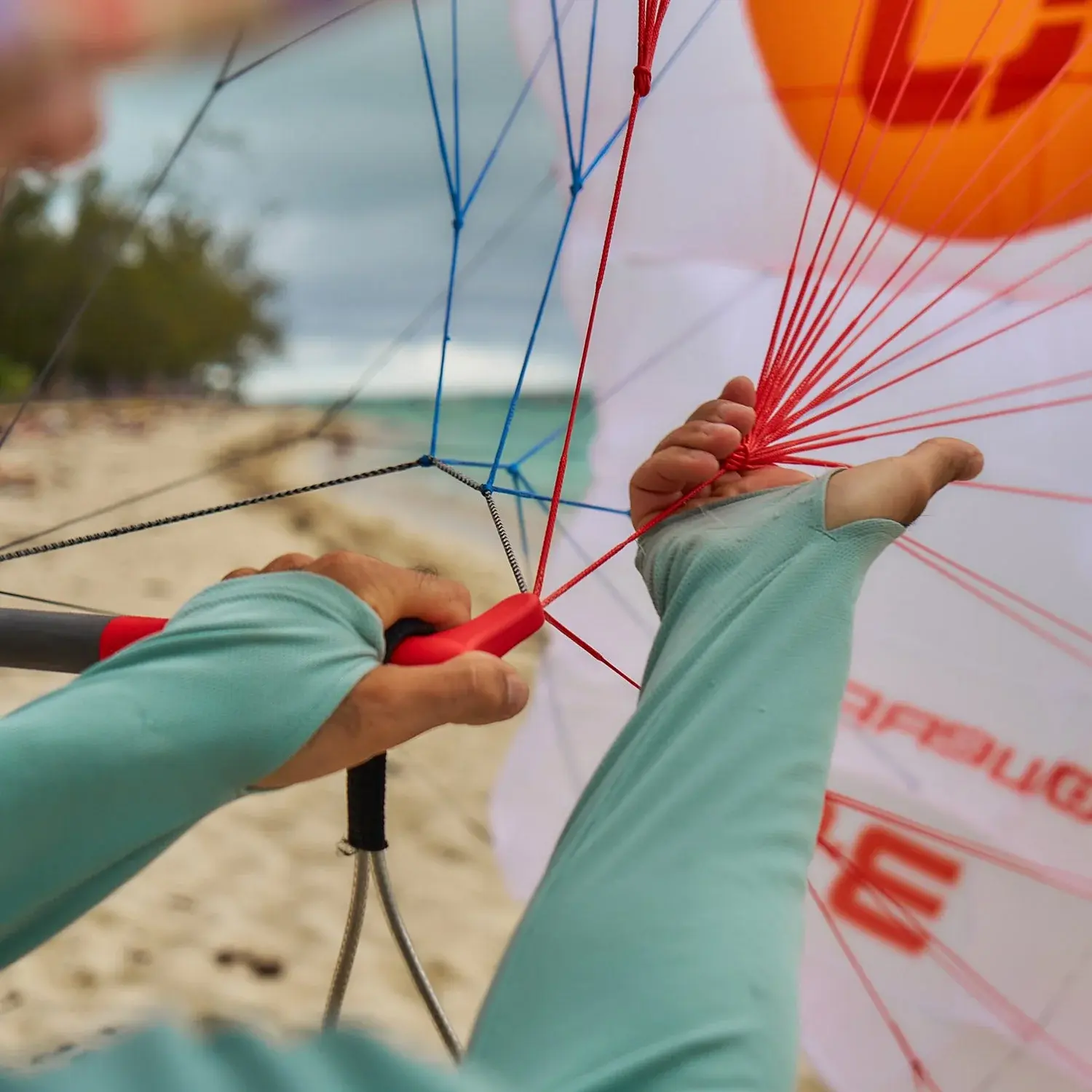
At 36cm the Bow Bar is shorter than the Pocket Rocket’s 40cm and replaces the central leader line with a floating yoke running front to back, leaving the bar clear of lines across its span. Ash rates that length as close to ideal for a stash belt.
Usage Profile Beats Spec Sheet
The most useful argument about this wing is not on any spec sheet. It comes from Ash of Wing-Tips, an independent reviewer with no commercial relationship with Ozone, who bought all three of his PowerPacks himself from his local shop and rides equipment for a long stretch before filming rather than forming a verdict in a day. He came to it from a 4.3m and then a 3.0m Pocket Rocket, so the comparison is owner to owner.
His point is that most parawing reviews come from one kind of spot: clean offshore conditions, long-period swell, a rider going miles upwind then riding a single wave for fifteen or twenty minutes. On that profile upwind ability genuinely is the headline metric, because getting upwind is most of the work and the wing spends the rest of the session stowed.
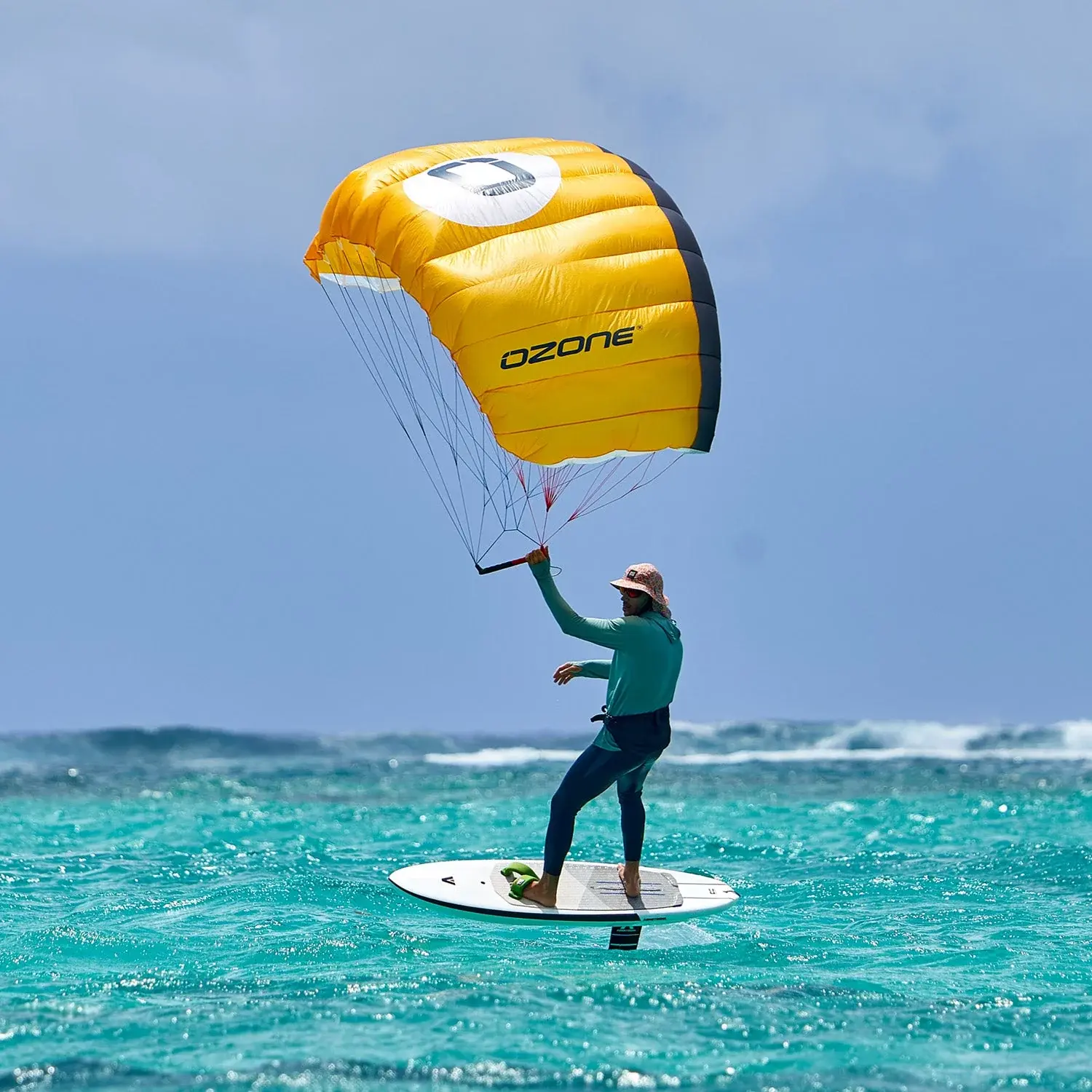
Most UK spots are the opposite. Weak, wind-blown, short-period swell, where a ride is often under thirty seconds and sometimes as little as five before you throw the wing out again to regain power. There the session is dozens of stash-and-redeploy cycles, and what decides whether you enjoy it is how reliably the wing goes away and comes back. Ash will trade a little upwind angle and a little speed for stash and redeploy he can depend on.
His Pocket Rocket ownership is what gives that weight, and it is a caveat on a line we have run for a long time, including elsewhere on this site: that the Pocket Rocket is the default Ozone parawing. On his account it earns that reputation for going upwind and riding a long swell, and is poor at what a weak short-period spot demands. He found it hard to pull out of the sky when fully powered, prone to spinning and tangling once down, and prone to failed redeploys even when packed tidily. Enough of the session went on untangling that parawinging became something he did occasionally, in perfect conditions, and did not much enjoy. That does not make it a worse wing, but it makes the choice conditional on where you ride, which is not how either is sold.
The Stash-Speed Case
Read through that lens, stash speed stops being a convenience feature and becomes the point of the wing.
Ash’s account of the mechanism is specific. The PowerPack falls out of the sky the moment you pull it down, even fully powered, which is what he could never get the Pocket Rocket to do. Thrown back out it inflates immediately and pulls onto power, and the failed redeploys he does get usually trace to him tangling the lines himself during a wave ride rather than the wing knotting itself.
The payoff compounds rather than adding up, and that is the real argument. In his words: “I cannot overstress just how much this changes your riding when you know it will stash instantly and redeploy perfectly.” His summary is in the title of his review: this is the wing that made him enjoy using parawings.
The costs are real but smaller than Ozone’s own framing suggests. Ash found it slightly slower and pointing a very small amount less upwind. It sits further back in the window so it pulls harder, a non-issue for him because he rides in a harness full time, and it is a touch more sensitive to back stalling, solved by keeping your hands forward.
Depower: Less Range, More Control
The depower comparison is not the simple one the spec sheets imply, and Ash’s reading of it is the most interesting technical point in his review.
Hang off the Pocket Rocket’s front lines and it depowers a great deal, but the rear of the canopy flaps and you lose steerage completely: depowered without being controllable. The PowerPack depowers less, but hung right off the A lines it stays fully steerable unless conditions are absolutely nuking.
Because you keep control through the depower, you can cut higher upwind and shed power with board angle instead of dumping it all from the wing. So the smaller depower range is partly offset by remaining usable across it, and the practical upwind gap may be narrower than the raw numbers suggest. Neither approach is simply better: one gives you more depower you cannot steer through, the other less that you can.
Who It Is For, and Who It Is Not
Ozone state they do not recommend the PowerPack for learning, “as it is not designed to withstand the wear and tear potentially caused during the learning process”, and describe the target rider as already experienced and committed to stash-and-glide.
Two claims often get run together there, including in our own earlier write-up. Ozone’s stated reason is durability: the wing is not built to survive being dragged up beaches while you work out the basics. That is a construction argument and it stands. The separate suggestion that the PowerPack is harder to fly is what Ash disputes, having come to it from two Pocket Rockets: “I didn’t find this parawing any more difficult to ride than a pocket rocket. So scratch the for experts only marketing.” That is one owner’s view against Ozone’s official line rather than settled fact, but it means the case against the PowerPack as a first parawing rests on durability and on upwind, not on difficulty. He is blunt about the launch too, calling it “one of the least convincing product launches I’d ever seen”: he bought one anyway on the strength of the stash claims, intending to sell it if it disappointed, then kept it and bought two more sizes.
It is for you if: you ride weak, short-period or wind-blown swell where rides are short and the wing goes in and out constantly, you spend more of the session foiling hands-free than powered up, and you ride in a harness.
It is not for you if: you need one wing for everything, you ride loops from a single launch and must make ground back under power, or you are still learning, where the durability caveat and the upwind step down both count against it. In those cases the Pocket Rocket V2 is the better tool.
Pros and Cons
Pros:
- Falls out of the sky the moment you pull it down, even fully powered
- Less than an arm’s length of pull to fully stash, and that holds on the 4.3m
- Pre-separated centre A lines, stiffer and unspliced, kinder to cold hands
- Floating yoke keeps the bar clear, so open-palm mittens work, and the shorter bar suits a stash belt
- Much less inclined to spin and tangle once down, and redeploys reliably
- Stays steerable through depower, so you can shed power on board angle
- Published wind ranges for every size, which several competitors still do not
Cons:
- Slightly slower, and points a very small amount less upwind (MACkite score it 7 out of 10 against the Pocket Rocket’s 10)
- Sits further back in the window so it pulls harder, more noticeable without a harness
- A touch more sensitive to back stalling, needing hands kept forward
- Ozone do not recommend it for learning on durability grounds
- No published weights or pack dimensions, so no direct comparison against lighter rivals
- Premium pricing in all three currencies, at or above the Pocket Rocket V1
- Owner-reported low end on the 3.6m is well above Ozone’s published figure
Community Feedback
The most substantial feedback comes from Ash of Wing-Tips, and it carries weight because of how it was arrived at: three sizes bought with his own money, ridden long term, by someone who owned two Pocket Rockets first and has no commercial relationship with Ozone. His verdict is that stash and redeploy reliability, not any performance figure, is what turned parawinging into something he enjoys.
The two spec-led reviews are both dealer-published and agree on the mechanism. MACkite’s Tucker Vantol tested the 3.6m and summarised the trade-off directly: “I would happily trade a little bit of upwind performance for the stowability and ease of use.” Wake-Style’s phrasing is that the wing “genuinely disappears” when packed, and they add one irritation nobody else mentions: the carry bag’s chest straps are fiddly once removed.
Rider discussion is more sceptical, which is healthy. On the Progression Project forum one experienced rider questioned the value: if you are giving up upwind, buy a used BRM Maliko V1 for a third of the price. He also noted there is likely more total line length on a 3.6m PowerPack than on a 21m Ozone R1 V5 foil kite, a fair point about complexity in a wing sold on simplicity.
What is still missing is a non-commercial head-to-head against the Duotone Stash or the North Ranger, and the two reviews with full spec detail both come from retailers who stock the wing. But the central claim, that the stash and redeploy cycle is reliable enough to change how a session feels, no longer rests only on sources with a commercial interest.
What It Costs
The PowerPack sits in the premium tier, listing below the Pocket Rocket V2 in every currency. Note that it costs more than the Pocket Rocket V1 in sterling and euros despite having fewer ribs and shorter lines: you are paying for line management, not materials.
We do not publish prices. See our guide to where to buy parawing gear to check today’s figure at a shop that will sell you one.
How Does the PowerPack Compare?
PowerPack vs Ozone Pocket Rocket
The comparison to make now is against the Pocket Rocket V2, which Ozone listed on 1 May 2026 and which borrows its shortened bridle from this wing. The V1 is still sold as run-out stock, but it is no longer the current model.
Ash of Wing-Tips has since ridden a 4.3m of each and the picture is more specific than it was. The V2 takes the top end clearly, flying further forward in the window, and takes speed, upwind and back-stall resistance too; on the V2 you can hold an upwind angle even off foil, which the PowerPack will not do. The PowerPack keeps stowing and redeploy, by a clear margin, and keeps steering, because the V2’s longer lines and looser rear lines make it less reactive under heavy depower. On the low end he calls it a draw, reached differently: the V2 rewards being pumped, while the PowerPack wants a more downwind angle to build momentum.
So for one wing in mixed conditions the Pocket Rocket V2 is the safer purchase and the more capable all-rounder. Choose the PowerPack deliberately, for repeated stow and redeploy, for lapping a swell spot, and for waves, which is the split Ash himself rides: a 4.3m V2 for light wind and covering ground, PowerPacks at 3.6, 3.0 and 2.4 where his rideable swell actually sits.
PowerPack vs Duotone Stash
Both are built around the stash concept and solve it differently. The Stash is a hybrid, single-skin centre with double-skin wingtips, buying structure and handling at the cost of packed volume. The PowerPack strips ribs and cells instead. Without published PowerPack weights we cannot settle packability with numbers, which is exactly the comparison a buyer wants, but on design intent the PowerPack is the more single-minded stash wing.
PowerPack vs North Ranger
The North Ranger is the other openly downwind-specialist parawing, and the two make opposite bets. North built the Ranger heavy and durable in 40 GSM fabric (1,350g at 4.2m) with a Depower Tab handbrake, priced well below the premium tier. For shuttle-assisted downwinders on a budget it costs considerably less and its Depower Tab has no equivalent here, but for repeated stash and redeploy within a run its weight is a real handicap.
PowerPack vs F-One Frigate
Not really competitors, and useful for that reason. The Frigate is the benchmark all-rounder: eight sizes from 1.9m to 6.5m, strong upwind, the widest coverage of any single model, and it sits at the top of the market, dearer than the PowerPack at comparable sizes. Choose the Frigate if you want one parawing that does everything, the PowerPack only if stash reliability matters more than versatility.
Sizing Guide
| Rider Weight | Light Wind (12-18 kts) | Moderate (18-28 kts) | Strong Wind (28-43 kts) |
|---|---|---|---|
| Under 70kg | 4.3m | 3.0m | 1.9m |
| 70-85kg | 5.0m | 3.6m | 1.9m-2.4m |
| Over 85kg | 5.0m | 4.3m | 2.4m-3.0m |
Derived from Ozone’s published wind ranges, which assume an 80kg rider: size down a step if lighter, up if heavier. Because the PowerPack sits deeper in the window, riders coming from a Pocket Rocket often find the equivalent size feels powered up sooner. See our parawing size guide for all brands.
Treat the light-wind column with caution: the owner-reported low end on the 3.6m is nearer 20 knots than Ozone’s 14, so size up if you ride marginal wind.
Where to Buy
UK: Ozone Kites UK (ozone-uk.com, custom colours), Fluid Lines (fluid-lines.co.uk), Hydrofoil Store (hydrofoilstore.com), The Watersports Centre (thewatersportscentre.com)
US: REAL Watersports (realwatersports.com), MACkite Boardsports (mackiteboarding.com), Green Hat Kiteboarding (greenhatkiteboarding.com)
EU: Wake-Style (wake-style.com, Germany), Kiteworldshop (kiteworldshop.com)
Australia: Kitepower Australia (kitepower.com.au), Kite Republic (kiterepublic.com.au)
Stock is patchy: every size on Ozone UK’s own store showed as unavailable when we checked. See our where to buy guide and our guide to buying from the EU.
Frequently Asked Questions
Is the Ozone PowerPack a good first parawing?
Probably not, though the usual reasoning is muddled. Ozone’s objection is durability: they say it is not built to withstand the wear and tear of learning. Ash of Wing-Tips, who owns three, disputes the separate idea that it is harder to fly, and found it no harder than a Pocket Rocket. The case against it as a first wing rests on durability and on the upwind step down, not on difficulty.
What is the difference between the PowerPack and the Pocket Rocket?
Lower aspect ratio, fewer ribs, shorter bridle lines, a 36cm bar with a floating yoke and no central lines, and pre-separated centre A lines. It sits deeper in the wind window, so it pulls more downwind and goes upwind slightly less well, and it stashes and redeploys far more reliably. Our Ozone brand overview sets the range side by side.
Does the PowerPack go upwind?
Yes, a very small amount less well, with MACkite scoring it 7 out of 10 against the Pocket Rocket’s 10. The gap may matter less than it looks, because staying steerable while depowered lets you hold a higher line and shed power with board angle.
The Verdict
The interesting question about the PowerPack is not whether it is good but whether your spot rewards what it does. Ozone sold it on stash speed and talked it down everywhere else, and the long-term owner evidence suggests the stash claim is the real one.
That is a genuine caveat on our own default advice. We have long pointed riders at the Pocket Rocket first, and for clean long-period conditions or a single-wing quiver that still holds. For the weak, short-period swell most UK riders actually get, where a session is dozens of five to thirty second rides separated by a stash and a redeploy, reliability of that cycle is worth more than a couple of degrees upwind.
Ash has since ridden the Pocket Rocket V2 against this wing in matched 4.3m sizes, and it sharpens rather than overturns that. The V2 is the more capable all-rounder, taking top end, speed, upwind and back stall. The PowerPack keeps stowing, redeploy and steering. What the comparison changes is how you pick: not just by your spot, but by size and wind. His own answer is a 4.3m V2 for light wind and covering ground, with PowerPacks at 3.6, 3.0 and 2.4 where his rideable swell sits and stash reliability decides the session.
The reservations stand. Ozone charge more than for the Pocket Rocket in GBP and EUR while publishing neither weights nor pack dimensions, so the packability case rests partly on adjectives, and there is still no independent head-to-head against the Stash or the Ranger. The durability caveat also means this is not the wing to learn on, whatever its handling. For a first Ozone, or one wing to cover everything, the Pocket Rocket V2 is now the answer, with the F-One Frigate and Flysurfer POW the other all-rounders worth a shortlist. Buy the PowerPack because you want what it is good at, not as a general-purpose wing.
Head-to-Head Comparisons
- Ozone Pocket Rocket V2 review: Ash of Wing-Tips, whose ownership anchors this page, has since compared a 4.3m V2 against a 4.3m PowerPack category by category and set out five use cases for choosing between them. The PowerPack still wins stowing, redeploy and steering.
- F-One Frigate vs Ozone Pocket Rocket: premium all-rounders compared
- North Ranger vs Ozone Pocket Rocket: Depower Tab vs paraglider pedigree
- Duotone Stash vs Ozone Pocket Rocket: mainstream backing vs paraglider pedigree
- BRM Kanaha vs Ozone Pocket Rocket: the pioneer vs paraglider pedigree
Images courtesy of Ozone.
Want more reviews like this?
Get notified when we publish new reviews, gear guides, and the best parawing deals.
More on Ozone
Our brand overview covers Ozone's history, full product range, and where to buy.
Read the Ozone brand overview